Article
Melatonin, Photoperiod and Reproductive Physiology in the Mare and Foal: Clinical Insights for Breeding Management
Reproductive seasonality in horses is a classic example of how environmental cues shape endocrine function and fertility. For veterinarians and breeders, understanding how daylight, melatonin, and management practices interact is not merely theoretical, it directly influences breeding efficiency, foaling outcomes, and neonatal health.
Photoperiod as the Primary Regulator of the Equine Breeding Cycle
Horses are long-day breeders, and increasing daylight during spring is the main trigger that initiates cyclic ovarian activity. Longer days suppress melatonin secretion, which in turn reactivates the hypothalamus–pituitary–ovary axis (HPOA), leading to increased gonadotropin-releasing hormone (GnRH), luteinizing hormone (LH), and follicle-stimulating hormone (FSH) secretion1.
Conversely, prolonged darkness during autumn and winter increases melatonin concentration, inhibiting GnRH and LH release and maintaining seasonal anoestrus2. Field observations confirm that the highest natural fertility in mares coincides with the longest daylight periods of mid-summer.
Interestingly, melatonin concentrations in mares do not differ significantly between follicular and luteal phases, highlighting that photoperiod rather than ovarian status is the dominant regulator2.
Seasonal Melatonin Patterns: What Clinicians Should Expect
During summer, exogenous melatonin administration can induce anoestrus without the use of additional steroids, offering a management tool for preventing oestrus during competition seasons3. Intravenous melatonin during pro-oestrus has been shown to reduce oestradiol and progesterone concentrations in the subsequent luteal phase, reinforcing its suppressive reproductive role2.
Mechanism of Action: From Retina to Ovary
Melatonin acts as a chemical messenger translating light–dark information into endocrine responses. Light perception through melanopsin-containing retinal cells transmits signals via the optic nerve and retinohypothalamic tract to the pineal gland, regulating melatonin secretion4.
In horses, increased melatonin during darkness suppresses GnRH, FSH, and LH secretion, directly inhibiting expression of the sexual cycle. Importantly, melatonin secretion in horses is primarily light-dependent rather than endogenously driven, making management lighting a powerful clinical tool2.
Practical Implications of Artificial Lighting
Artificial light as low as 3 lux can disrupt nocturnal melatonin synthesis. Strategically extending perceived daylight during winter has long been used to induce earlier ovarian activity and ovulation in barren mares, especially in racing industries where foaling dates are economically critical2.
Breeding seasons can also be prolonged by extending daily photoperiod either before sunrise or after sunset, offering flexibility in reproductive scheduling. However, while effective, these interventions may have unintended endocrine consequences around parturition2.
Periparturient Melatonin: Emerging Evidence in Mares and Foals
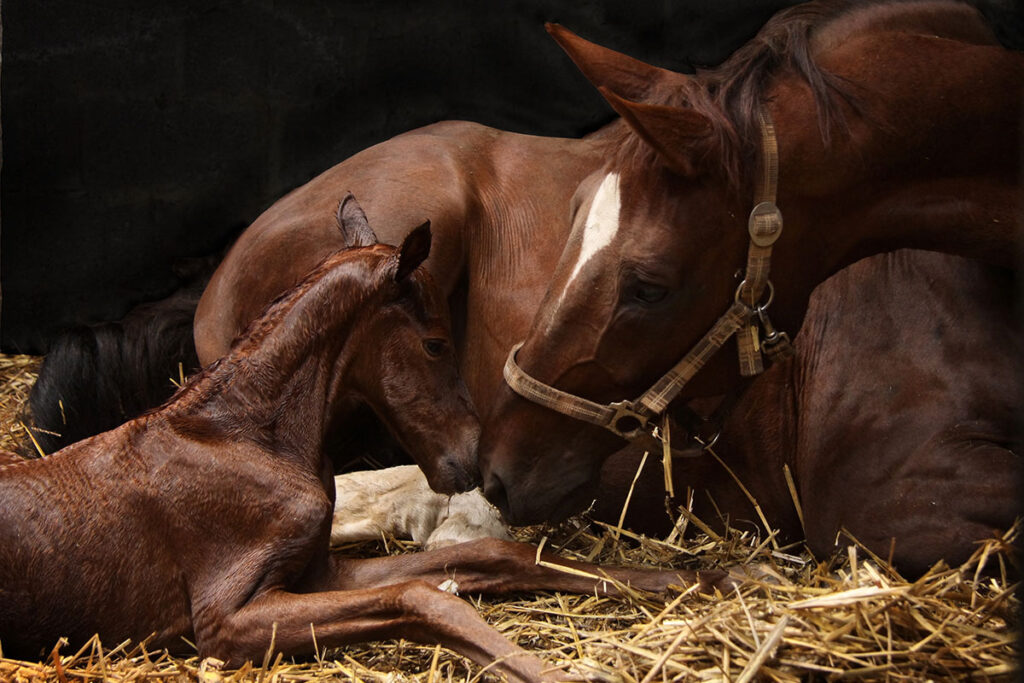
Data on melatonin dynamics during equine gestation and the periparturient period have historically been limited. Recent findings demonstrate that plasma melatonin concentration in mares at foaling averages around 34.6 pg/mL, while newborn foals show lower concentrations (approximately 27.6 pg/mL). Over the first 12 hours postpartum, melatonin levels decline more sharply in mares than in foals, regardless of foaling time2.
This rapid maternal decline is likely related to placental loss, as the placenta is considered a significant extrapineal source of melatonin, similar to humans5,6. The more stable melatonin levels in foals suggest either immature light responsiveness or partial independence of neonatal melatonin secretion.
Clinical Relevance for Neonatal Assessment
Melatonin plays antioxidant, anti-inflammatory, anxiolytic, and analgesic roles and contributes to central nervous system and placental development. Given these functions, melatonin concentration may become a useful adjunct biomarker in neonatal assessment, alongside traditional parameters such as passive transfer of immunoglobulins2.
Impact of Light Supplementation Late in Pregnancy
Daytime light supplementation during late gestation significantly reduces nocturnal melatonin concentration at foaling. Foals born to light-supplemented mares have lower melatonin levels at birth compared with controls. Although no immediate differences were observed in colostrum IgG content or growth parameters over the first year of life7,8, the potential long-term implications for health and performance warrant caution and further research.
Key Takeaways for Veterinary Practice
- Melatonin is a central regulator of seasonal reproduction in mares and is primarily controlled by light exposure.
- Artificial lighting is an effective but biologically powerful tool that should be used judiciously, particularly during late pregnancy.
- Periparturient melatonin dynamics differ between mares and foals, with placental loss playing a key role in postpartum decline.
- Monitoring melatonin in neonates may, in future, complement existing neonatal health assessments.
A deeper understanding of melatonin physiology allows veterinarians to balance breeding efficiency with mare and foal welfare, ensuring that reproductive management aligns with both biological rhythms and performance demands.
References
- Nolan, M. B., Walsh, C. M., Duff, N., McCrarren, C., Prendergast, R. L. and Murphy, B. A. (2017): Artificially extended photoperiod administered to pre-partum mares via blue light to a single eye: observations on gestation length, foal birth weight and foal hair coat at birth. Theriogenology 100, 126–133. https://doi.org/10.1016/j.theriogenology.2017.06.012.
- Gáspárdy A, Gallagher G, Bartha B, Cseh S, Fekete SG, Somoskői B. Plasma melatonin concentration during the early post-partum period in Thoroughbred mares and their foals. Acta Veterinaria Hungarica. 2023 Oct 17;71(2):119-27. https://akjournals.com/downloadpdf/view/journals/004/71/2/article-p119.pdf
- Ovid, D., Hayes, T. B. and Bentley, G. E. (2018): Melatonin administration methods for research in mammals and birds. J. Biol. Rhythms 33, 567–588. https://doi.org/10.1177/ 0748730418795802
- Talpur, H. S., Chandio, I. B., Brohi, R. D., Worku, T., Rehman, Z., Bhattarai, D., Ullah, F., JiaJia, L. and Yang, L. (2018): Research progress on the role of melatonin and its receptors in animal reproduction: a comprehensive review. Reprod. Domest. Anim. 53, 831–849. https://doi.org/10.1111/rda.13188
- Hardeland, R. (2017): Melatonin – more than just a pineal hormone. Biomed. J. Sci. Tech. Res. 1(4). https://doi.org/10.26717/ BJSTR.2017.01.000351
- Ejaz, H., Figaro, J. K., Woolner, A. M. F., Thottakam, B. M. V. and Galley, H. F. (2021): Maternal serum melatonin increases during pregnancy and falls immediately after delivery implicating the placenta as a major source of melatonin. Front. Endocrinol. 11: 623038. https://doi.org/10.3389/fendo.2020.623038.
- Lutzer, A., Nagel, C., Aurich, J., Murphy, B. A. and Aurich, C. (2022a): Development of foals until one year of age when the dam was exposed to blue monochromatic light directed at one eye during late pregnancy. J. Equine Vet. Sci. 112: 103922. https://doi.org/10.1016/j.jevs.2022.103922
- Lutzer, A., Nagel, C., Murphy, B. A., Aurich, J., Wulf, M., Gautier, C. and Aurich, C. (2022b): Effects of blue monochromatic light directed at one eye of pregnant horse mares on gestation, parturition and foal maturity. Domest. Anim. Endocrinol. 78: 106675. https://doi.org/10.1016/j.domaniend. 2021.106675
Related Contents
.jpg)
Video
Transjugular Removal of Canine Heartworms: A Clinical and Surgical Overview
Transjugular removal of canine heartworms is a specialized intervention used in selected dogs with s...

Article
Feline Pregnancy Endocrinology: Hormonal Changes and Placental Function
Pregnancy in cats involves a distinctive endocrine pattern in which ovarian and placental hormones w...

Article
Hormonal Control of Pregnancy Termination in Cats
Pregnancy maintenance in cats depends strongly on coordinated hormonal support, particularly progest...

Article
Feline Embryo Implantation and Early Placental Development
Pregnancy establishment in cats involves a sequence of precisely timed events between fertilization,...

Article
Ultrasonographic Monitoring of Pregnancy in Cats: A Gestational Timeline
Ultrasonography provides a practical way to follow the progression of feline pregnancy by identifyin...

Article
Feline Mismating: Pregnancy Diagnosis and Clinical Management
Mismating or unplanned mating is a common clinical problem in sexually mature queen cats because of...

Article
Medical Termination of Pregnancy in Queens: Drugs, Timing and Treatment Protocols
Medical termination of pregnancy (MTP) in queen cats should be approached according to the timing of...

Article
Safety and Aftercare Following Pregnancy Termination in Queen Cats
Pregnancy termination in queen cats requires more than selecting an appropriate abortifacient. Once...