Article
Diagnosis, Vaccination, and Field Control of IBD: Bridging Gaps Between Theory and Practice
Despite widespread vaccination, Infectious Bursal Disease continues to cause outbreaks globally. The challenge lies not just in controlling the virus, but in adapting strategies to its evolving nature and field realities.
Diagnostic Approaches: Choosing the Right Tool1
Diagnosis of IBD depends on combining clinical suspicion with laboratory confirmation. During the acute phase, the virus is most reliably detected in the bursa within the first 3 days post-infection.
Traditional methods like agar gel immunodiffusion (AGID) are simple but lack sensitivity. ELISA-based assays offer improved detection, especially when based on recombinant VP2 or VP3 proteins.
Molecular diagnostics have become the gold standard. RT-PCR targeting the hypervariable VP2 region allows precise strain identification and phylogenetic analysis. Real-time RT-PCR further enhances sensitivity and throughput, making it suitable for large-scale surveillance.
For field-level detection, LAMP assays and rapid strip tests provide quick and reliable results without sophisticated infrastructure.
Vaccination Challenges in the Field
Vaccination remains the cornerstone of IBD control, but its success is often compromised by several factors:
- Interference from maternally derived antibodies (MDA)
- Antigenic mismatch with circulating strains
- Improper timing of vaccination
Live attenuated vaccines, though widely used, carry risks of reversion to virulence and may fail against vvIBDV strains1. Inactivated vaccines are primarily used in breeder flocks to confer maternal immunity, but they do not provide immediate protection to chicks.
Optimizing Vaccination Strategies
Timing is critical. Vaccinating too early leads to neutralization by MDA, while delayed vaccination leaves birds unprotected1. Serological monitoring of antibody levels is therefore essential for determining the optimal vaccination window.
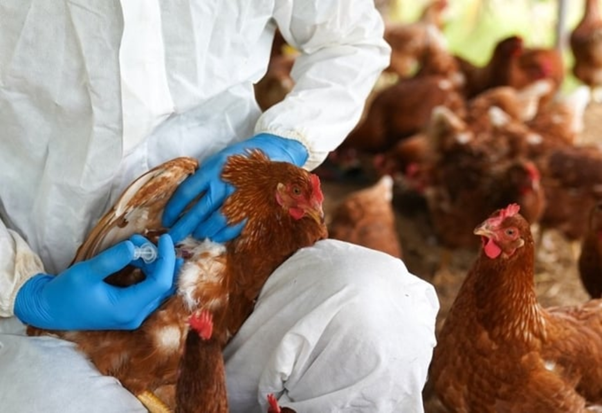
Mass vaccination through drinking water or spray is practical, but uniformity of dose remains a challenge in field conditions.
New-Generation Vaccines: Are They the Solution?
Advances in vaccine technology are addressing many limitations of conventional vaccines. Subunit vaccines targeting VP2 offer safer alternatives with DIVA capability, though they require boosters2.
Virus-like particle (VLP) vaccines mimic the native virus structure without containing genetic material, offering strong immunogenicity and safety. DNA vaccines and immune complex vaccines provide additional strategies, particularly in overcoming MDA interference1.
Vector-based vaccines, such as those using turkey herpesvirus (HVT-VP2), are gaining attention due to their safety and ability to induce long-lasting immunity without causing bursal damage1.
Biosecurity and Farm Management
Vaccination alone cannot control IBD. The virus is highly resistant and can persist in poultry houses for up to 122 days1. Strict hygiene, disinfection, and control of mechanical vectors like rodents and insects are essential components of disease management.
Subclinical infections, often overlooked, are a major cause of economic loss due to poor growth and increased susceptibility to other diseases.
Conclusion
Effective control of IBD requires a multi-pronged approach combining accurate diagnostics, strategic vaccination, and stringent biosecurity. For veterinarians, the focus should shift from routine protocols to evidence-based, flock-specific strategies. As the virus continues to evolve, so must our approach to managing it in the field.
Reference
- Dey S, Pathak DC, Ramamurthy N, Maity HK, Chellappa MM. Infectious bursal disease virus in chickens: prevalence, impact, and management strategies. Veterinary Medicine: Research and Reports. 2019 Aug 5:85-97. https://www.tandfonline.com/doi/pdf/10.2147/VMRR.S185159
- Maity HK, Dey S, Mohan CM, Khulape SA, Pathak DC, Vakharia VN. Protective efficacy of a DNA vaccine construct encoding the VP2 gene of infectious bursal disease and a truncated HSP70 of Mycobacterium tuberculosis in chickens. Vaccine. 2015 Feb 18;33(8):1033-9. https://www.academia.edu/download/41685094/Protective_efficacy_of_a_DNA_vaccine_con20160128-6556-6cun3j.pdf
Related Contents
.jpg)
Video
Transjugular Removal of Canine Heartworms: A Clinical and Surgical Overview
Transjugular removal of canine heartworms is a specialized intervention used in selected dogs with s...

Article
Feline Pregnancy Endocrinology: Hormonal Changes and Placental Function
Pregnancy in cats involves a distinctive endocrine pattern in which ovarian and placental hormones w...

Article
Hormonal Control of Pregnancy Termination in Cats
Pregnancy maintenance in cats depends strongly on coordinated hormonal support, particularly progest...

Article
Feline Embryo Implantation and Early Placental Development
Pregnancy establishment in cats involves a sequence of precisely timed events between fertilization,...

Article
Ultrasonographic Monitoring of Pregnancy in Cats: A Gestational Timeline
Ultrasonography provides a practical way to follow the progression of feline pregnancy by identifyin...

Article
Feline Mismating: Pregnancy Diagnosis and Clinical Management
Mismating or unplanned mating is a common clinical problem in sexually mature queen cats because of...

Article
Medical Termination of Pregnancy in Queens: Drugs, Timing and Treatment Protocols
Medical termination of pregnancy (MTP) in queen cats should be approached according to the timing of...

Article
Safety and Aftercare Following Pregnancy Termination in Queen Cats
Pregnancy termination in queen cats requires more than selecting an appropriate abortifacient. Once...