Article
Vaccine-Induced Immunity and Prevention of CIRDC
Introduction
Vaccination plays a critical role in controlling canine infectious respiratory disease complex. While several vaccines are available against B. bronchiseptica, vaccines targeting CPI are less commonly included in traditional oral vaccine formulations1,2.
Recent research has focused on bivalent oral vaccines combining CPI and B. bronchiseptica antigens to provide broader respiratory protection.
Immune Response Following Oral Vaccination
Systemic Immune Response
The bivalent oral vaccine induces strong humoral immunity1:
- CPI neutralizing antibody seroconversion occurred in 91% of vaccinated dogs
- 100% seroconversion was observed for B. bronchiseptica antibodies
Post-challenge antibody responses were approximately 10 times higher in vaccinated dogs compared to placebo animals, suggesting strong immunological memory formation1.
Mucosal Immune Response
Oral vaccination stimulates mucosa-associated lymphoid tissue (MALT), especially the nasopharyngeal tonsils.
Mucosal immunity prevents1,2:
- Pathogen adhesion
- Viral replication
- Mucosal tissue invasion
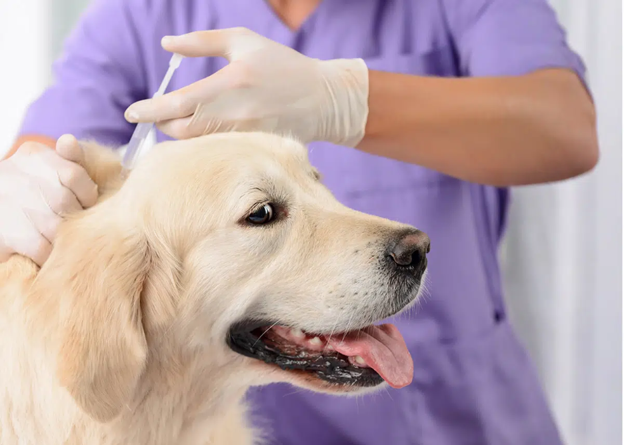
The specialised vaccine delivery applicator produces a fine mist that improves antigen exposure to mucosal immune tissues.
Clinical Protection Outcomes
Protection Against CPI1
Vaccinated dogs demonstrated:
- 83% reduction in viral shedding duration
Reduced viral shedding helps:
- Decrease environmental contamination
- Reduce outbreak spread
Protection Against B. bronchiseptica1
Vaccinated animals showed:
- 65% reduction in coughing duration
- Lower disease incidence compared to placebo controls
Clinical disease occurred in 74% of placebo dogs, significantly higher than vaccinated animals.
Duration of Immunity1
Protection was demonstrated for at least 12 months after a single vaccine dose.
Antibody titers against B. bronchiseptica peaked around 35 days post-vaccination and remained stable for one year.
Epidemiological Impact
Reduced coughing frequency is important because coughing increases airborne droplet dispersion. Vaccination therefore reduces both clinical disease severity and transmission potential within canine populations.
Importance of Mucosal Vaccination
Mucosal vaccines provide:
- Local immune defense at infection entry sites
- Rapid pathogen neutralization
- Improved respiratory disease control
Respiratory pathogens typically first interact with mucosal surfaces, making mucosal immunity highly relevant.
Vet Pearls
- Oral vaccines are particularly useful for improving compliance in multi-dog environments.
- MALT stimulation is key for respiratory pathogen prevention.
- Reducing coughing directly reduces environmental pathogen spread.
Conclusion
Bivalent oral vaccination provides effective long-term protection against CIRDC pathogens. A single vaccine dose can provide protection for at least 12 months while significantly reducing viral shedding and clinical disease severity.
Vaccination programs remain essential tools for controlling respiratory outbreaks in high-density canine populations.
References
- Wiechert-Brown SA, Classe HM, Dant JC, LaFleur RL, Xu Z, Tarpey I. One year duration of immunity of a combination Bordetella bronchiseptica-canine parainfluenza oral vaccine in dogs. Frontiers in Veterinary Science. 2025 Oct 14;12:1634190. https://www.frontiersin.org/journals/veterinary-science/articles/10.3389/fvets.2025.1634190/pdf
- Scott‐Garrard M, Wang X, Chiang YW, David F. Thirteen‐month duration of immunity of an oral canine vaccine against challenge with Bordetella bronchiseptica. Veterinary record open. 2020;7(1):e000423. https://bvajournals.onlinelibrary.wiley.com/doi/10.1136/vetreco-2020-000423
Related Contents
.jpg)
Video
Transjugular Removal of Canine Heartworms: A Clinical and Surgical Overview
Transjugular removal of canine heartworms is a specialized intervention used in selected dogs with s...

Article
Feline Pregnancy Endocrinology: Hormonal Changes and Placental Function
Pregnancy in cats involves a distinctive endocrine pattern in which ovarian and placental hormones w...

Article
Hormonal Control of Pregnancy Termination in Cats
Pregnancy maintenance in cats depends strongly on coordinated hormonal support, particularly progest...

Article
Feline Embryo Implantation and Early Placental Development
Pregnancy establishment in cats involves a sequence of precisely timed events between fertilization,...

Article
Ultrasonographic Monitoring of Pregnancy in Cats: A Gestational Timeline
Ultrasonography provides a practical way to follow the progression of feline pregnancy by identifyin...

Article
Feline Mismating: Pregnancy Diagnosis and Clinical Management
Mismating or unplanned mating is a common clinical problem in sexually mature queen cats because of...

Article
Medical Termination of Pregnancy in Queens: Drugs, Timing and Treatment Protocols
Medical termination of pregnancy (MTP) in queen cats should be approached according to the timing of...

Article
Safety and Aftercare Following Pregnancy Termination in Queen Cats
Pregnancy termination in queen cats requires more than selecting an appropriate abortifacient. Once...