Article
Femur Fractures in Cats: A Practical Approach to Treatment Decision-Making
Femoral fractures in cats are challenging injuries that require careful planning. Successful management balances mechanical stability with biological preservation while considering patient age, fracture location, and soft-tissue status. Roberts & Meeson emphasize that implant choice should address fracture biomechanics and preserve the physis in juvenile cats¹. Intramedullary (IM) pins alone rarely provide adequate rotational control, making plate-based constructs, plate-rod combinations, or hybrid external skeletal fixation (ESF) preferred options¹.
Juvenile (Physeal) Fractures
Distal femoral Salter–Harris type I and II fractures are the most common physeal injuries in young cats². Early, minimally invasive stabilization reduces the risk of growth deformities.
Comparative Analysis:
- Cross-pinning or smooth K-wires: Minimally invasive, preserves the physis, low complication rates → suitable for simple, non-displaced fractures².
- Plating: Provides rigid fixation but may damage the physis → reserve for unstable or severely displaced fractures².
Outcomes: In 36 cases reviewed, physeal-sparing fixation achieved normal limb alignment in over 85% of cats².
Vet Pearls:
*Avoid crossing screws through the physis unless necessary.
*Early reduction is crucial to prevent angular deformities.
Diaphyseal (Shaft) Fractures
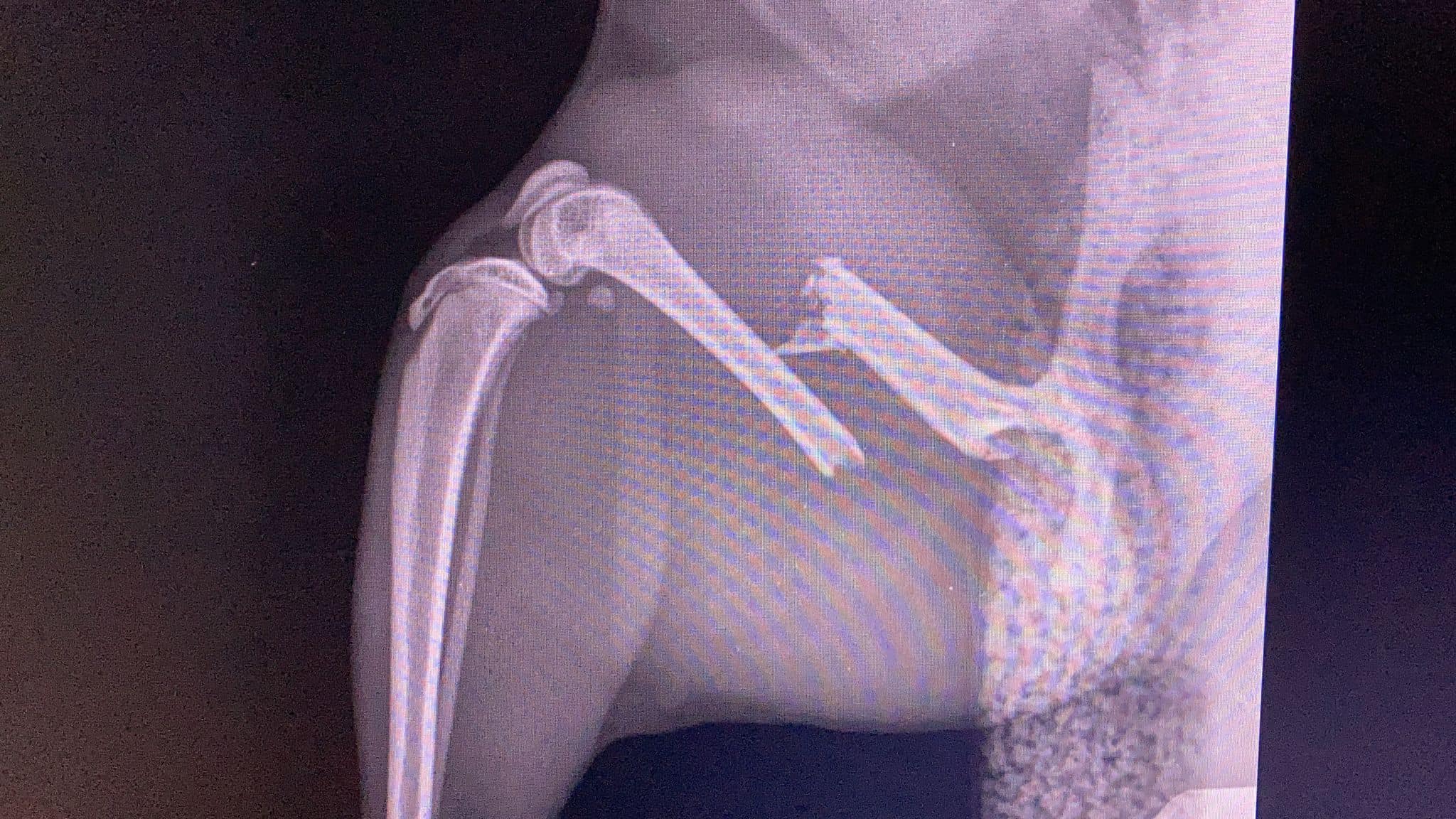
Mid-diaphyseal fractures face significant bending and torsional forces. Zurita & Craig found that rigid fixation using plates, locking plates, or plate-rod constructs ensures proper alignment and promotes healing³.
Comparative Analysis:
- IM pins alone: Minimally invasive, preserves soft tissue; high risk of rotational failure → suitable only for simple, low-load fractures¹³.
- Plate-rod constructs: Excellent rotational and bending stability; slightly more invasive → preferred for mid-shaft fractures with high torsional forces1,3.
- Locking plates: Rigid fixation, minimal soft-tissue disruption; ideal for comminuted fractures³.
Outcomes: Plate and plate-rod constructs showed fracture union in 92–95% of cases, with low complication rates1,3.
Vet Pearls:
*Always check rotational stability intraoperatively before closing.
*Plate-rod constructs provide the best combination of stability and biological preservation.
Distal Femur and Supracondylar Fractures
Distal femoral fractures are technically challenging due to limited bone stock and high joint forces. Yayla et al. reported that cross-pinning is effective for simple fractures, but unstable or comminuted patterns require more robust fixation⁴. Hybrid ESF stabilizes fractures when plating is difficult while preserving the soft tissue⁵.
Comparative Analysis:
- Cross-pinning: Minimally invasive, preserve soft tissue → suitable for simple fractures⁴.
- Hybrid ESF: Maintains alignment in unstable or comminuted fractures, protects soft tissue → preferred when bone purchase is limited⁵.
Outcomes: Hybrid ESF provides satisfactory alignment and functional recovery in over 80% of distal femur fractures⁵.
Vet Pearls:
*If two points of fixation distal to the fracture cannot be achieved, consider hybrid ESF early.
*Evaluate joint congruity carefully before finalizing fixation.
Proximal Femur and Trochanteric Fractures
Proximal fractures are complicated by strong muscular forces from the quadriceps and iliopsoas. Rustemeyer & Schmierer demonstrated that vastus release and fixation improve reduction in difficult proximal fractures⁶. Nurra et al. highlights the frequent occurrence of concurrent injuries, such as pelvic or diaphyseal fractures, emphasizing the need for comprehensive imaging⁷. Fixation may include tension-band wiring, lag screws, or plating¹.
Comparative Analysis:
- Vastus release and fixation: Facilitates reduction and prevents malalignment in complex fractures⁶.
- Lag screws or tension-band wiring: Suitable for isolated trochanteric fractures, minimal invasiveness6,7.
- Plating: Necessary for larger fragments or unstable fracture patterns6,7.
Outcomes: Vastus release combined with plate fixation achieved successful reduction and union in all four cats reported, with minimal complications⁶.
Vet Pearls:
*Consider vastus release if the quadriceps pull the fragment cranially.
*Always check for concurrent injuries to avoid missed fractures.
Soft-Tissue Management and Rehabilitation
Quadriceps contracture is a common complication. Gentle tissue handling, minimal periosteal stripping, and early controlled mobilization are essential for functional recovery1,3. Preserving the muscle envelope supports bone healing and reduces long-term stiffness.
Vet Pearls:
*The first 10 days post-op are critical start-controlled rehabilitation as soon as stability allows.
*Maintain soft-tissue integrity; it is as important as the fixation itself.
Integrated Clinical Decision Framework
- Assess age and physeal status: Juvenile cats → physeal-sparing fixation².
- Localize fracture and evaluate biomechanics:
- Proximal → vastus release and fixation, strong constructs6,7.
- Diaphyseal → plates, locking systems, or plate-rod constructs1,3.
- Distal → cross-pins if simple, hybrid ESF if unstable4,5.
- Evaluate soft-tissue envelope: Compromised → ESF or hybrid fixation1,5.
- Ensure rotational and axial stability: High torsional forces → plate-rod or locking plate1,3.
- Plan early rehabilitation: Prevent quadriceps contracture1,3.
Conclusion
Management of feline femoral fractures requires an evidence-based, structured approach that considers fracture location, patient age, and soft-tissue condition. Juvenile fractures benefit from physeal-sparing fixation; diaphyseal fractures need rigid constructs, distal fractures may require hybrid ESF, and proximal fractures often necessitate vastus release and fixation. Early rehabilitation and careful soft-tissue handling are essential to prevent complications and maximize functional recovery.
References
- Roberts VJ, Meeson RL. Feline femoral fracture fixation: what are the options? J Feline Med Surg. 2022;24(5):442–463. Available from: https://journals.sagepub.com/doi/full/10.1177/1098612X221090391
- Rubinos C, Meeson RL. Traumatic physeal fractures in cats: a review of 36 cases (2010–2020). J Feline Med Surg. 2022;24(2):98–106.
- Zurita M, Craig A. Feline diaphyseal fractures: management and treatment options. J Feline Med Surg. 2022;24(7):662–74.
- Yayla S, Altan S, Çatalkaya E, Kanay BE, Saylak N. Evaluation of supracondylar femur fractures in cats: a retrospective study. Iran J Vet Sci Technol. 2022;14(4):37–41.
- Gülaydın A, Alkan İ. Evaluation of distal femur fractures in cats by hybrid external fixator. Ankara Univ Vet Fak Derg. 2024;71(1):89–100.
- Rustemeyer L, Schmierer PA. Complete vastus release to repair complex proximal femoral fractures: description and follow-up in four cats. J Feline Med Surg. 2025;27(9):1098612X251367614. doi:10.1177/1098612X251367614
- Nurra G, Pilot M, Grek-Fritzner B, Coppola M, Grierson JM, Langley-Hobbs S. Fracture of the greater trochanter of the femur in 17 cats: imaging, clinical features and concurrent injuries. J Feline Med Surg. 2025;27(4):1098612X241305918. doi:10.1177/1098612X241305918
Related Experts

Dr. Kunal Dev Sharma
Director of MaxPetZ, a leading veterinary surgeon, educator, and innovator with nearly two decades of clinical excellence. A third-generation veterinarian and member of the Royal College of Veterinary...
Veterinary
Related Contents
.jpg)
Video
Transjugular Removal of Canine Heartworms: A Clinical and Surgical Overview
Transjugular removal of canine heartworms is a specialized intervention used in selected dogs with s...

Article
Feline Pregnancy Endocrinology: Hormonal Changes and Placental Function
Pregnancy in cats involves a distinctive endocrine pattern in which ovarian and placental hormones w...

Article
Hormonal Control of Pregnancy Termination in Cats
Pregnancy maintenance in cats depends strongly on coordinated hormonal support, particularly progest...

Article
Feline Embryo Implantation and Early Placental Development
Pregnancy establishment in cats involves a sequence of precisely timed events between fertilization,...

Article
Ultrasonographic Monitoring of Pregnancy in Cats: A Gestational Timeline
Ultrasonography provides a practical way to follow the progression of feline pregnancy by identifyin...

Article
Feline Mismating: Pregnancy Diagnosis and Clinical Management
Mismating or unplanned mating is a common clinical problem in sexually mature queen cats because of...

Article
Medical Termination of Pregnancy in Queens: Drugs, Timing and Treatment Protocols
Medical termination of pregnancy (MTP) in queen cats should be approached according to the timing of...

Article
Safety and Aftercare Following Pregnancy Termination in Queen Cats
Pregnancy termination in queen cats requires more than selecting an appropriate abortifacient. Once...