Article
A Quick Clinical Guide to Reducing Pin Loosening in External Skeletal Fixation
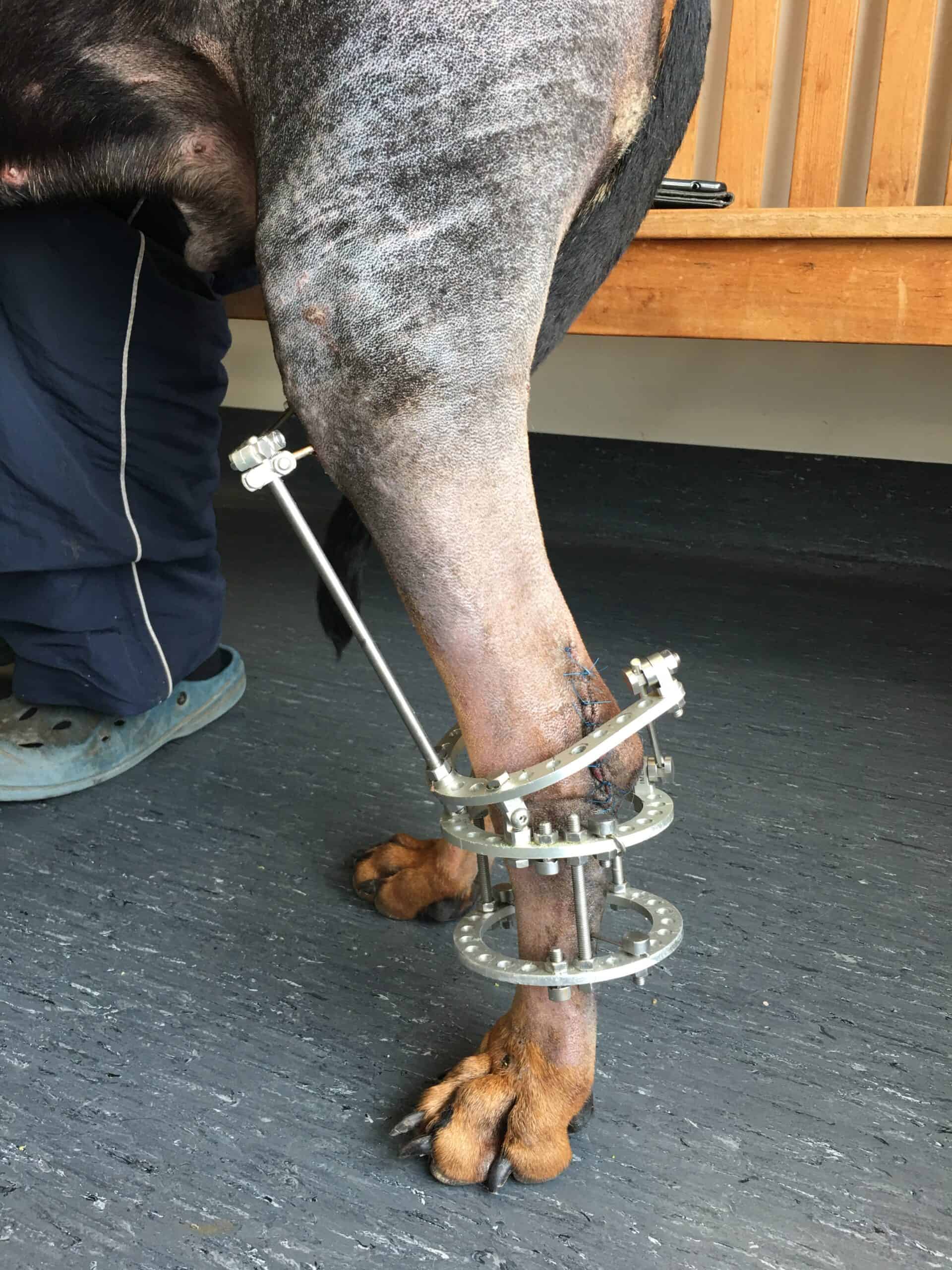
Pin loosening remains one of the most common challenges faced during external skeletal fixation (ESF) in veterinary orthopaedics. While it cannot always be prevented, several practical chairside strategies can significantly lower the risk. This quick clinical guide summarises the key considerations every surgeon should keep in mind to optimise construct stability and protect the pin–bone interface.
1. Choosing the Right Pin Size
Pin size plays a fundamental role in ESF success. The recommendation is to select a pin measuring 20–30% of the bone’s diameter, using pre-operative radiographs for accuracy. While smaller pins may seem safer, even pins just 20% of the bone diameter can reduce bone strength by up to 38%. However, larger pins increase the risk of creating a critical defect upon removal. Surgeons must balance sufficient rigidity with minimal bone compromise, understanding that narrower pins may reduce construct stiffness and contribute to fracture instability1.
2. Optimal Number of Pins
Increasing the number of pins enhances the overall stiffness of an external skeletal fixator by distributing mechanical load more evenly across the construct, reducing the burden on any single pin. Current guidelines recommend placing at least two pins in each main bone fragment and generally three to four pins per fracture segment, as this range provides stable fixation without excessive cortical disruption. Using too few pins can weaken the construct, increase pin–bone interface stress, and predispose the fixation to loosening. Ensuring an adequate number of pins is therefore essential for achieving reliable long-term stability1,2.
3. Pin Insertion Technique Matters
Pin insertion technique plays one of the most critical roles in preventing pin loosening and maintaining long-term construct stability in external skeletal fixation. Pins should be inserted as close to perpendicular to the long axis of the bone as possible, and self-tapping (“underdog”) pins are best avoided, as they can increase microdamage and promote loosening. High-speed placement helps reduce long-term extraction forces compared with low-speed placement, while controlled forward drilling pressure prevents excessive cortical heating, which can otherwise lead to thermal necrosis and compromised fixation. When femoral or humeral fractures warrant the use of an intramedullary (IM) pin as an adjunct, the IM pin is placed first. During retrograde placement, only a minimal approach should be made, handling just the main proximal and distal fragments while leaving intermediate pieces untouched to preserve their blood supply. The IM pin must be undersized to allow subsequent fixation-pin placement, for example, a 1–2 mm Kirschner wire in cats and, when a minimal approach is used, this is also an ideal moment to add cancellous bone graft if required. Proper drilling technique remains essential throughout, as elevated cortical temperatures from excessive drilling pressure contribute directly to thermal necrosis and early pin loosening1,3.
4. Pre-Drilling a Pilot Hole
Pre-drilling is a valuable technique shown to increase pull-out strength by 13.5%. It also reduces microfracture damage to cortical bone at the entry and exit points. The recommended pilot hole size is 10% smaller than the pin diameter, ensuring a positive profile fit. A drill sleeve should always be used to minimise soft tissue trauma during pin placement1.
5. Maintaining Equipment Quality
The condition of drills and equipment cannot be overlooked, as worn or poor-quality drill bits significantly increase heat generation and cortical microdamage, both of which predispose to pin loosening. Reprocessed drill bits may be used in some settings, but their performance depends heavily on proper maintenance and sharpness. Surgeons should ensure all equipment is sharp, well-maintained, and thermally efficient to minimize iatrogenic heating. Positive-profile threaded pins can also help reduce loosening by providing stronger mechanical engagement with bone compared with smooth or negative-profile threaded pins1.
6. Importance of Irrigation
Adequate irrigation during drilling is a simple yet effective measure to keep temperatures below critical thresholds. This reduces the risk of thermal necrosis and protects the longevity of the implant–bone interface, especially when using larger drill bits1.
Minimising pin loosening requires consistency, precision, and attention to detail. By integrating these evidence-based considerations into routine practice, veterinarians can enhance construct stability, reduce complications, and ensure smoother fracture healing outcomes.
References
- Beever, L., Giles, K., & Meeson, R. (2017). Postoperative complications associated with external skeletal fixators in cats. Journal of Feline Medicine and Surgery, 19(7), 727–736. Full text: https://pmc.ncbi.nlm.nih.gov/articles/PMC11129199/
- Zurita M, Craig A. Feline diaphyseal fractures: management and treatment options. Journal of Feline Medicine and Surgery. 2022 Jul;24(7):662-74.
- Saini, D. (2024). Comparative study of arrow pinning and dynamic intramedullary cross pinning for surgical management of long bone fractures in cat. Doctoral dissertation, Maharashtra Animal and Fishery Sciences University.
Related Contents
.jpg)
Video
Transjugular Removal of Canine Heartworms: A Clinical and Surgical Overview
Transjugular removal of canine heartworms is a specialized intervention used in selected dogs with s...

Article
Feline Pregnancy Endocrinology: Hormonal Changes and Placental Function
Pregnancy in cats involves a distinctive endocrine pattern in which ovarian and placental hormones w...

Article
Hormonal Control of Pregnancy Termination in Cats
Pregnancy maintenance in cats depends strongly on coordinated hormonal support, particularly progest...

Article
Feline Embryo Implantation and Early Placental Development
Pregnancy establishment in cats involves a sequence of precisely timed events between fertilization,...

Article
Ultrasonographic Monitoring of Pregnancy in Cats: A Gestational Timeline
Ultrasonography provides a practical way to follow the progression of feline pregnancy by identifyin...

Article
Feline Mismating: Pregnancy Diagnosis and Clinical Management
Mismating or unplanned mating is a common clinical problem in sexually mature queen cats because of...

Article
Medical Termination of Pregnancy in Queens: Drugs, Timing and Treatment Protocols
Medical termination of pregnancy (MTP) in queen cats should be approached according to the timing of...

Article
Safety and Aftercare Following Pregnancy Termination in Queen Cats
Pregnancy termination in queen cats requires more than selecting an appropriate abortifacient. Once...