Article
Cranial Cruciate Ligament Disease in Dogs
Introduction
Cranial cruciate ligament disease (CCLD) is a frequent cause of hindlimb lameness in dogs. The cranial cruciate ligament (CCL) stabilizes the stifle joint by limiting forward movement of the tibia relative to the femur. When the ligament is compromised, it contributes to stifle instability, pain, and progressive osteoarthritis, significantly affecting mobility and quality of life in affected dogs.
Etiology and Risk Factors
CCLD results from a combination of degenerative changes and biomechanical stress. Dogs with conformational features such as an increased tibial plateau angle are more susceptible to ligament overload and subsequent stifle dysfunction. Additionally, breed predispositions, obesity, and activity level influence the development and progression of disease by increasing mechanical stress on the stifle joint1,2.
Clinical Presentation
Dogs with CCLD commonly present with variable hindlimb lameness, which may be intermittent initially before becoming persistent. Physical signs frequently include stifle pain, joint effusion, and quadriceps muscle atrophy. Orthopedic tests such as the cranial drawer and tibial compression tests are essential components of a thorough clinical evaluation to detect instability1,2.
Functional Assessment Using Goniometry
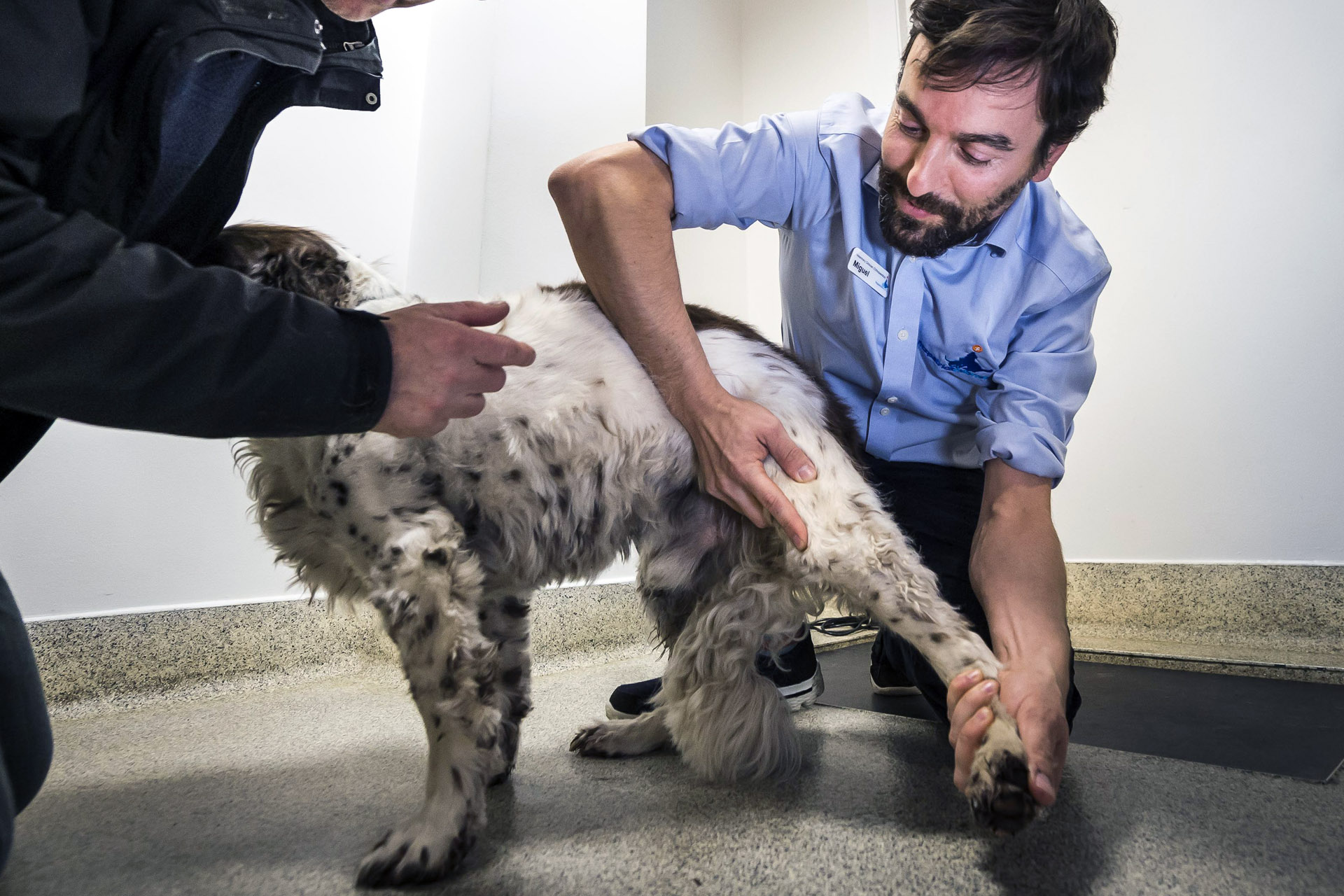
Assessment of stifle range of motion (ROM) through goniometry offers valuable functional information. In dogs affected by CCLD, maximum stifle extension is often reduced compared with healthy counterparts, while flexion may remain relatively preserved. The accuracy of goniometric measurements is influenced by patient compliance during joint manipulation, but standardized measurement techniques yield excellent intra‑observer and inter‑observer reliability. This makes goniometry a practical tool for monitoring joint function and response to treatment in clinical practice3.
Patellar Ligament Changes
In dogs suffering from CCLD, the patellar ligament undergoes detectable morphological changes. Ultrasonographic and elastosonographic evaluation shows that as the time between onset of lameness and clinical intervention increases, the patellar ligament tends to become thicker and less elastic. These changes reflect altered biomechanical loading of the stifle and may have implications for both diagnosis and rehabilitation planning4.
Diagnosis
Clinical evaluation is the cornerstone of diagnosis. Advanced imaging modalities such as computed tomography (CT) and magnetic resonance imaging (MRI) can assist in identifying subtle instability and intra‑articular pathology when physical examination findings are ambiguous. Imaging also helps clarify stifle anatomy before surgical interventions1,2.
Management Options
Management of CCLD is tailored to the individual patient, considering factors such as size, activity level, and clinical severity. Non-surgical options — including weight management, non-steroidal anti-inflammatory drugs (NSAIDs), and controlled exercise — may be appropriate for smaller or less active dogs. These measures aim to reduce pain, maintain muscle strength, and optimize joint function1,2.
For most active or larger dogs, surgical stabilization is recommended to restore joint stability. Common surgical techniques include extracapsular stabilization using lateral fabellar suture and tibial osteotomy procedures such as tibial plateau leveling osteotomy (TPLO) or tibial tuberosity advancement (TTA). Combining surgical methods may enhance joint stability and outcome in selected cases1,2.
Meniscal Considerations
Meniscal tears often accompany CCLD and contribute to ongoing pain and osteoarthritis if left unaddressed. Medial meniscal injury is especially prevalent in unstable stifles. Clinical evaluation of the menisci during stabilization surgery and appropriate management, such as partial meniscectomy or repair, helps reduce postoperative lameness and preserves joint health1,2.
Rehabilitation and Long-Term Care
Postoperative rehabilitation play a key role in restoring limb function, reducing stiffness, and improving patient comfort. Controlled exercise, hydrotherapy, and progressive strengthening of the hindlimb musculature support recovery. Long-term care should emphasize weight control and appropriate activity modification to reduce joint stress and limit osteoarthritic progression1,2,3.
Conclusion
Effective management of canine CCLD requires a comprehensive clinical approach, including careful assessment, individualized treatment planning, and structured rehabilitation. Functional tools like goniometry and ultrasonographic assessment of the patellar ligament offer objective insights into joint health and help guide decision-making. By recognizing conformational risks and providing tailored supportive care, veterinarians can improve comfort, function, and long-term outcomes in dogs affected by CCLD.
Reference List
- Rafla M, Yang P, Mostafa A. Canine Cranial Cruciate Ligament Disease (CCLD): A Concise Review of the Recent Literature. Animals. 2025;15(7):1030.
- Bertorelli J, Arnold G, Mertens D. Correlation between the tibial plateau angle and occurrence of medial meniscal tears in dogs with complete cranial cruciate ligament rupture. BMC Vet Res. 2025;21:209.
- Volz F, Schmutterer JM, Vockrodt TS, Zablotski Y, Lauer SK. Inter‑rater reliability in performing stifle goniometry in normal and cranial cruciate ligament disease‑affected dogs. BMC Vet Res. 2024;20(1):339.
- Pennasilico L, Volta A, Sassaroli S, Di Bella C, Riccio V, Pilati N, Tambella AM, Dini F, Palumbo Piccionello A. Ultrasound and elastosonographic features of the patellar ligament in dogs affected by cranial cruciate ligament disease. Vet Sci. 2024;11(3):126.
Related Contents
.jpg)
Video
Transjugular Removal of Canine Heartworms: A Clinical and Surgical Overview
Transjugular removal of canine heartworms is a specialized intervention used in selected dogs with s...

Article
Feline Pregnancy Endocrinology: Hormonal Changes and Placental Function
Pregnancy in cats involves a distinctive endocrine pattern in which ovarian and placental hormones w...

Article
Hormonal Control of Pregnancy Termination in Cats
Pregnancy maintenance in cats depends strongly on coordinated hormonal support, particularly progest...

Article
Feline Embryo Implantation and Early Placental Development
Pregnancy establishment in cats involves a sequence of precisely timed events between fertilization,...

Article
Ultrasonographic Monitoring of Pregnancy in Cats: A Gestational Timeline
Ultrasonography provides a practical way to follow the progression of feline pregnancy by identifyin...

Article
Feline Mismating: Pregnancy Diagnosis and Clinical Management
Mismating or unplanned mating is a common clinical problem in sexually mature queen cats because of...

Article
Medical Termination of Pregnancy in Queens: Drugs, Timing and Treatment Protocols
Medical termination of pregnancy (MTP) in queen cats should be approached according to the timing of...

Article
Safety and Aftercare Following Pregnancy Termination in Queen Cats
Pregnancy termination in queen cats requires more than selecting an appropriate abortifacient. Once...