Article
Feline Allergic Dermatitis — Why Diagnosis is So Challenging
Feline allergic dermatitis does not follow predictable rules—and that is exactly why it is so often misdiagnosed. Unlike dogs, cats present with reaction patterns rather than disease-specific lesions, making clinical interpretation far more complex. The same presentation may arise from flea allergy, food allergy, atopy, or ectoparasitic disease, while the same disease can look entirely different across patients. The result is clear: pattern recognition alone is unreliable in feline dermatology1.
Why Feline Cases Are Frequently Misdiagnosed
The diagnostic challenge begins with the limited number of cutaneous reaction patterns seen in cats, combined with significant overlap between underlying causes. Flea allergy, food allergy, atopy, and parasitic diseases can all present similarly. Adding to this complexity is owner under-recognition of pruritus—clients often report “hair loss” or “overgrooming” rather than itch, leading to delays in appropriate workup. Ultimately, clinicians must remember that clinical appearance does not equal diagnosis1.
The Four Classic Reaction Patterns in Cats
Feline allergic disease typically presents through four major reaction patterns. Miliary dermatitis is characterized by small, crusted papules that create a “sandpaper” feel, most commonly along the dorsum, and is often—but not exclusively—associated with flea allergy. Self-induced alopecia presents as symmetrical hair loss caused by excessive grooming, which is frequently misinterpreted as an endocrine disorder, especially when owners do not observe the grooming behavior.
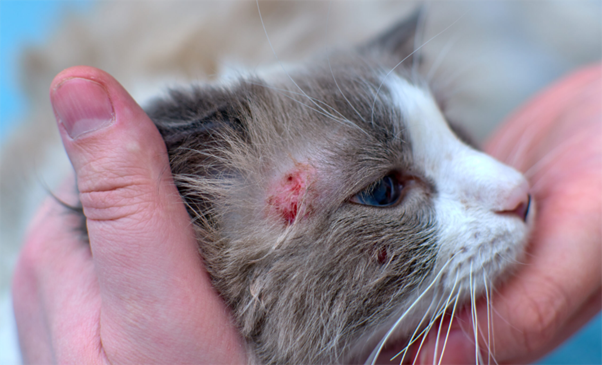
The eosinophilic granuloma complex (EGC) includes lesions such as indolent ulcers on the upper lip, eosinophilic plaques on the abdomen or medial thighs, and linear granulomas. Head and neck pruritus, on the other hand, is often dramatic, with severe excoriations affecting the face, ears, and neck, sometimes presenting acutely. Importantly, none of these patterns are specific to a single allergic condition, reinforcing the need for a structured diagnostic approach1.
Owner Perception — The Hidden Barrier
One of the most underestimated challenges in feline dermatology is owner perception. Many owners fail to recognize grooming as a sign of pruritus, instead attributing it to behavioral habits or stress. This often results in delayed presentation and misdiagnosis, particularly as psychogenic alopecia. Veterinarians must actively reframe this understanding—overgrooming is a clinical sign of itch, not merely behavior.
Common Clinical Pitfalls
Several recurring errors contribute to poor outcomes in feline allergic cases. These include skipping flea control in indoor cats, misdiagnosing alopecia as an endocrine disorder, and relying on symptomatic therapy without completing a diagnostic workup. Each shortcut increases the likelihood of chronic, unresolved disease.
Key Takeaway
Feline allergic dermatitis is not difficult because it is rare—it is difficult because it is deceptive. In cats, what you see is not what you get. Diagnosis begins when assumptions end.
Reference
- Miller J, Simpson A, Bloom P, Diesel A, Friedeck A, Paterson T, Wisecup M, Yu CM. 2023 AAHA management of allergic skin diseases in dogs and cats guidelines. Journal of the American Animal Hospital Association. 2023 Nov 1;59(6):255-84. https://www.aaha.org/wp-content/uploads/globalassets/02-guidelines/2023-aaha-management-of-allergic-skin-diseases-in-dogs-and-cats-guidelines/resources/2023-aaha-management-of-allergic-skin-diseases-guidelines.pdf
Related Contents
.jpg)
Video
Transjugular Removal of Canine Heartworms: A Clinical and Surgical Overview
Transjugular removal of canine heartworms is a specialized intervention used in selected dogs with s...

Article
Feline Pregnancy Endocrinology: Hormonal Changes and Placental Function
Pregnancy in cats involves a distinctive endocrine pattern in which ovarian and placental hormones w...

Article
Hormonal Control of Pregnancy Termination in Cats
Pregnancy maintenance in cats depends strongly on coordinated hormonal support, particularly progest...

Article
Feline Embryo Implantation and Early Placental Development
Pregnancy establishment in cats involves a sequence of precisely timed events between fertilization,...

Article
Ultrasonographic Monitoring of Pregnancy in Cats: A Gestational Timeline
Ultrasonography provides a practical way to follow the progression of feline pregnancy by identifyin...

Article
Feline Mismating: Pregnancy Diagnosis and Clinical Management
Mismating or unplanned mating is a common clinical problem in sexually mature queen cats because of...

Article
Medical Termination of Pregnancy in Queens: Drugs, Timing and Treatment Protocols
Medical termination of pregnancy (MTP) in queen cats should be approached according to the timing of...

Article
Safety and Aftercare Following Pregnancy Termination in Queen Cats
Pregnancy termination in queen cats requires more than selecting an appropriate abortifacient. Once...