Article
Oral Fluid Therapy in Adult Cattle with Dehydration and Electrolyte Imbalance
Oral fluid therapy is effective in adult cattl1e due to the high bioavailability of sodium, which is approximately 90%. Sodium absorption from the forestomach drives passive movement of water into the extracellular space, making it central to rehydration. This mechanism functions optimally only when rumen motility is normal, with active sodium transport contributing significantly to daily absorption1.
Clinical Relevance in Field Conditions
Dehydration and electrolyte imbalance are common in adult cattle, often associated with reduced feed intake, systemic illness, or gastrointestinal disturbances such as diarrhea. In many of these cases, oral fluid therapy provides a practical and cost-effective method of rehydration when the rumen is functioning adequately1.
However, in animals with rumen atony or hypomotility, orally administered fluids may accumulate in the rumen, delaying absorption and limiting clinical benefit. In such situations, particularly when dehydration is severe, intravenous fluid therapy, including hypertonic saline, should be initiated first, with oral therapy introduced once rumen function improves1.
Electrolyte Composition: What Matters in Practice
An effective oral electrolyte solution (OES) should contain sodium, potassium, and chloride. This is particularly important because dehydrated cattle with reduced feed intake frequently develop hypochloremic, hypokalemic metabolic alkalosis1,2.
Although additional minerals such as calcium and magnesium are often included, overly complex formulations can reduce effectiveness. Interactions between dissolved salts may decrease solubility or interfere with absorption, which is often overlooked in field practice1,3,4. Simpler formulations are therefore generally more reliable.
Importance of Osmolality in Rehydration
The tonicity of oral fluids plays a critical role in treatment success. Hypotonic solutions are preferred, as they promote the movement of water from the rumen into circulation, supporting effective rehydration.
In contrast, hypertonic oral solutions can draw water into the rumen, increasing rumen volume while worsening systemic dehydration1. Although such solutions may reduce the volume required and stimulate voluntary water intake, they are less suitable when the primary goal is correction of dehydration.
Practical Formulations for Field Use
In routine practice, simple electrolyte mixtures are most effective. Common formulations include sodium chloride, potassium chloride, and calcium chloride dissolved in water, producing solutions close to isotonic levels. Some variations also include magnesium chloride for broader electrolyte support1,5.
These formulations, however, may not provide sufficient potassium in cases of significant hypokalemia, and supplementation should be adjusted based on clinical assessment1.
Volume and Administration Strategy
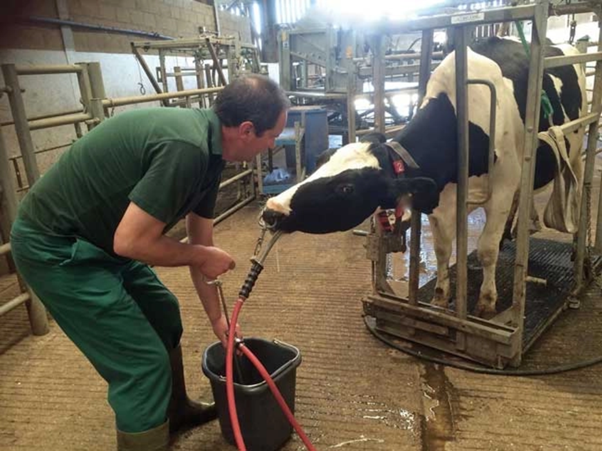
Adult cattle can tolerate large volumes of oral fluids due to the rumen’s capacity as a fluid reservoir. A minimum of 20 liters is typically recommended, while moderately to severely dehydrated animals may safely receive 40 to 60 liters1.
Plain water should be avoided in large quantities because of the risk of dilutional hyponatremia. Hypotonic electrolyte solutions are preferred to maintain osmotic balance and improve fluid absorption.
Safety Considerations
Careful administration is essential to minimize complications. Cold fluids should be avoided, as they can disrupt rumen microbial activity and contribute to hypothermia. Additionally, animals with ruminal distension or impaired reflexes are at increased risk of regurgitation and aspiration, requiring appropriate technique and handling during administration.
Role in Specific Clinical Conditions
In conditions such as ruminal acidosis or grain overload, oral sodium bicarbonate can be used as an adjunct therapy. At appropriate doses, it helps correct systemic acidosis and supports recovery1.
Practical Take-Home Message
Oral fluid therapy is a highly effective tool for managing dehydration and electrolyte imbalance in adult cattle when used in the right clinical context. Its success depends on proper case selection, appropriate formulation, and adequate volume administration. In animals with compromised rumen function or severe dehydration, intravenous therapy should be prioritized before transitioning to oral rehydration. Keeping formulations simple and aligned with physiological principles ensures better outcomes in field practice.
Reference
- Constable PD, Trefz FM, Sen I, Berchtold J, Nouri M, Smith G, Grünberg W. Intravenous and oral fluid therapy in neonatal calves with diarrhea or sepsis and in adult cattle. Frontiers in veterinary science. 2021 Jan 27;7:603358. https://doi.org/10.3389/fvets.2020.603358
- Dabbir BK, Rajavolu SR. New trends in the treatment of hypokalemia in cows. InLatest Scientific Findings in Ruminant Nutrition-Research for Practical Implementation 2024 Jun 10. IntechOpen. https://www.intechopen.com/chapters/1181750
- Grünberg W, Dobbelaar P, Breves G. Kinetics of phosphate absorption in lactating dairy cows after enteral administration of sodium phosphate or calcium phosphate salts. British journal of nutrition. 2013 Sep;110(6):1012-23. https://www.cambridge.org/core/services/aop-cambridge-core/content/view/3E3188FF456E3187CB27D9CD4708C682/S0007114513000160a.pdf/kinetics_of_phosphate_absorption_in_lactating_dairy_cows_after_enteral_administration_of_sodium_phosphate_or_calcium_phosphate_salts.pdf
- Cohrs I, Grünberg W. Suitability of oral administration of monosodium phosphate, disodium phosphate, and magnesium phosphate for the rapid correction of hypophosphatemia in cattle. J Vet Intern Med. 2018;32(3):1253–1258. https://doi:10.1111/jvim.15094
- Constable PD, Hiew MW, Tinkler S, Townsend J. Efficacy of oral potassium chloride administration in treating lactating dairy cows with experimentally induced hypokalemia, hypochloremia, and alkalemia. Journal of Dairy Science. 2014 Mar 1;97(3):1413-26. https://www.journalofdairyscience.org/article/S0022-0302(13)00870-9/fulltext
Related Contents
.jpg)
Video
Transjugular Removal of Canine Heartworms: A Clinical and Surgical Overview
Transjugular removal of canine heartworms is a specialized intervention used in selected dogs with s...

Article
Feline Pregnancy Endocrinology: Hormonal Changes and Placental Function
Pregnancy in cats involves a distinctive endocrine pattern in which ovarian and placental hormones w...

Article
Hormonal Control of Pregnancy Termination in Cats
Pregnancy maintenance in cats depends strongly on coordinated hormonal support, particularly progest...

Article
Feline Embryo Implantation and Early Placental Development
Pregnancy establishment in cats involves a sequence of precisely timed events between fertilization,...

Article
Ultrasonographic Monitoring of Pregnancy in Cats: A Gestational Timeline
Ultrasonography provides a practical way to follow the progression of feline pregnancy by identifyin...

Article
Feline Mismating: Pregnancy Diagnosis and Clinical Management
Mismating or unplanned mating is a common clinical problem in sexually mature queen cats because of...

Article
Medical Termination of Pregnancy in Queens: Drugs, Timing and Treatment Protocols
Medical termination of pregnancy (MTP) in queen cats should be approached according to the timing of...

Article
Safety and Aftercare Following Pregnancy Termination in Queen Cats
Pregnancy termination in queen cats requires more than selecting an appropriate abortifacient. Once...