Article
Intravenous Fluid Therapy in Adult Cattle: Choosing the Right Fluids for Alkalosis and Acidosis
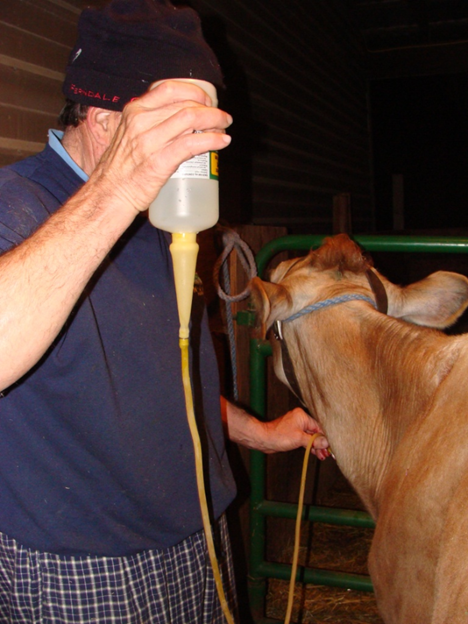
Oral fluid therapy is indicated in diarrheic neonatal calves that are able to stand and suckle. Early initiation at the onset of diarrhea is recommended, as progression to dehydration is unpredictable1. Calves that are recumbent, lack a suckle reflex, or show marked dehydration (eye recession ≥4 mm) should receive intravenous fluids in addition to oral therapy1.
Daily fluid requirement is approximately 12% or more of body weight, divided into 2–3 feedings over 24 hours1. Milk feeding should be continued alongside oral electrolyte therapy.
What to Look for in an Oral Electrolyte Solution (OES)
|
Parameter |
Recommended Range / Feature |
Clinical Relevance |
|
Sodium |
90–130 mmol/L |
Corrects hyponatremia and expands extracellular volume; milk alone is insufficient1,2,3 |
|
Alkalinizing capacity (SID) |
40–80 mmol/L (optimum ~60) |
Corrects metabolic acidosis; SID = 0 solutions are not recommended1,4 |
|
Alkalinizing agents |
Bicarbonate / acetate / propionate / citrate |
1acts rapidly; acetate/propionate may inhibit Salmonella spp1. |
|
Osmolality |
300–700 mOsm/kg |
<300 inadequate; >600 may delay abomasal emptying and risk bloat1 |
|
Energy source |
Glucose ± glycine |
Supports sodium absorption; excessive glucose may cause fermentation/glycosuria1,2 |
|
Potassium |
Included |
Addresses intracellular depletion in diarrheic calves |
Feeding and Administration1,5
|
Situation |
Recommended Approach |
|
Calf able to suckle |
Oral OES and continue milk feeding |
|
Moderate dehydration |
Increase frequency of OES feeds |
|
Severe signs (recumbent, no suckle) |
Add IV fluids |
|
Initial rehydration |
Prefer OES in water for better plasma expansion |
|
With milk feeding |
Use isotonic OES; avoid mixing equal volumes of milk and OES |
|
Water access |
Always provide free access |
Key Practical Points
- Diarrheic calves are typically hyponatremic, unlike human infants
- Continue milk feeding; withholding may lead to hypoglycemia within 8–16 hours1
- Feeding milk and OES improves recovery and weight gain
- High-osmolality or high-glucose solutions may delay abomasal emptying and worsen outcomes
Field Application
A standing, suckling calf with diarrhea can be managed with continued milk feeding plus 1–2 OES feeds/day, reassessing within 24 hours. Lack of improvement or worsening clinical status should prompt escalation to intravenous therapy.
Conclusion
Oral fluid therapy is effective in neonatal calf diarrhea when used early and appropriately. Clinical success depends on correct case selection and choosing an OES with adequate sodium, alkalinizing capacity, and appropriate osmolality, with timely transition to intravenous therapy when indicated.
References
- Constable PD, Trefz FM, Sen I, Berchtold J, Nouri M, Smith G, Grünberg W. Intravenous and oral fluid therapy in neonatal calves with diarrhea or sepsis and in adult cattle. Frontiers in veterinary science. 2021 Jan 27;7:603358. https://doi.org/10.3389/fvets.2020.603358
- Wilms JN, Leal LN, Martín-Tereso J. Hypernatremia in diarrheic calves associated with oral electrolyte administration in water and milk replacer in absence of access to water. Journal of dairy science. 2020 Jun 1;103(6):5495-500. https://www.journalofdairyscience.org/article/S0022-0302(20)30267-8/fulltext
- Wilms JN, Echeverry‐Munera J, Engelking L, Leal LN, Martín‐Tereso J. Tonicity of oral rehydration solutions affects water, mineral and acid–base balance in calves with naturally occurring diarrhoea. Journal of animal physiology and animal nutrition. 2020 Nov;104(6):1655-70. https://doi.org/10.1111/jpn.13405
- Sayers, R.G., Kennedy, A., Krump, L., Sayers, G.P. and Kennedy, E., 2016. An observational study using blood gas analysis to assess neonatal calf diarrhea and subsequent recovery with a European Commission-compliant oral electrolyte solution. Journal of Dairy Science, 99(6), pp.4647-4655.
- Wenge J, Steinhöfel I, Heinrich C, Coenen M, Bachmann L. Water and concentrate intake, weight gain and duration of diarrhea in young suckling calves on different diets. Livestock Science. 2014 Jan 1;159:133-40. https://doi.org/10.1016/j.livsci.2013.11.004
Related Contents
.jpg)
Video
Transjugular Removal of Canine Heartworms: A Clinical and Surgical Overview
Transjugular removal of canine heartworms is a specialized intervention used in selected dogs with s...

Article
Feline Pregnancy Endocrinology: Hormonal Changes and Placental Function
Pregnancy in cats involves a distinctive endocrine pattern in which ovarian and placental hormones w...

Article
Hormonal Control of Pregnancy Termination in Cats
Pregnancy maintenance in cats depends strongly on coordinated hormonal support, particularly progest...

Article
Feline Embryo Implantation and Early Placental Development
Pregnancy establishment in cats involves a sequence of precisely timed events between fertilization,...

Article
Ultrasonographic Monitoring of Pregnancy in Cats: A Gestational Timeline
Ultrasonography provides a practical way to follow the progression of feline pregnancy by identifyin...

Article
Feline Mismating: Pregnancy Diagnosis and Clinical Management
Mismating or unplanned mating is a common clinical problem in sexually mature queen cats because of...

Article
Medical Termination of Pregnancy in Queens: Drugs, Timing and Treatment Protocols
Medical termination of pregnancy (MTP) in queen cats should be approached according to the timing of...

Article
Safety and Aftercare Following Pregnancy Termination in Queen Cats
Pregnancy termination in queen cats requires more than selecting an appropriate abortifacient. Once...