Article
Fetal to Neonatal Transition: Understanding Physiology at Birth in Puppies and Kittens
The transition from fetal to neonatal life in puppies and kittens represents a highly dynamic and vulnerable physiological process. Within minutes of birth, the newborn must adapt from a placenta-dependent system to independent respiration and circulation. Any delay or disruption in this transition may result in hypoxemia, cardiovascular instability, and the need for immediate resuscitative support. Understanding these physiological changes is therefore essential for veterinarians involved in perinatal care.
Fetal Physiology: A System Built Around the Placenta
During intrauterine life, gas exchange occurs exclusively through the placenta. The lungs are fluid-filled and do not participate in oxygenation. Circulatory patterns are also uniquely adapted, with the right and left ventricles functioning in parallel rather than in series1.
Blood flow is directed away from the lungs through fetal shunts such as the foramen ovale and ductus arteriosus. These structures allow oxygenated blood from the placenta to bypass the pulmonary circulation and preferentially supply vital organs, including the brain. This system is efficient in utero but must be rapidly restructured after birth.
The First Breaths: Initiating Lung Aeration
At birth, the removal of placental support necessitates immediate activation of pulmonary respiration. Lung aeration is a critical step in this process. Several mechanisms contribute to clearing fluid from the airways and enabling effective gas exchange.
Mechanical forces during labor, including uterine contractions and passage through the birth canal, help expel fluid from the lungs. Additionally, hormonal changes associated with birth promote absorption of residual fluid from the alveoli. The first inspiratory efforts generate high transpulmonary pressures, which further facilitate lung expansion and fluid clearance1.
Establishing functional residual capacity is essential for maintaining effective ventilation. Without adequate aeration, oxygenation cannot be achieved, and the transition process may be compromised.
Cardiovascular Adaptation: From Parallel to Series Circulation1
Simultaneously, profound cardiovascular changes occur. With the onset of lung aeration, pulmonary vascular resistance decreases, allowing increased blood flow through the lungs. At the same time, systemic vascular resistance rises due to the loss of placental circulation.
These changes alter intracardiac pressure gradients, leading to functional closure of fetal shunts. The foramen ovale closes as left atrial pressure increases, and blood flow through the ductus arteriosus diminishes. As a result, the ventricles begin to function in series, establishing the normal postnatal circulatory pattern.
This coordinated shift is essential for efficient oxygen delivery. However, it is highly sensitive to disturbances, particularly those affecting lung aeration.
When Transition Fails: Clinical Implications1
Failure or delay in the transition process is a common cause of neonatal compromise. Inadequate lung aeration leads to persistent high pulmonary vascular resistance, limiting blood flow through the lungs. This results in hypoxemia, which may manifest clinically as bradycardia, poor muscle tone, and inadequate respiratory effort.
Importantly, bradycardia in newborns is often a consequence of hypoxemia rather than primary cardiac dysfunction. This distinction is clinically relevant, as it supports the emphasis on improving ventilation rather than relying on pharmacologic interventions.
Supporting the Transition: Practical Considerations1
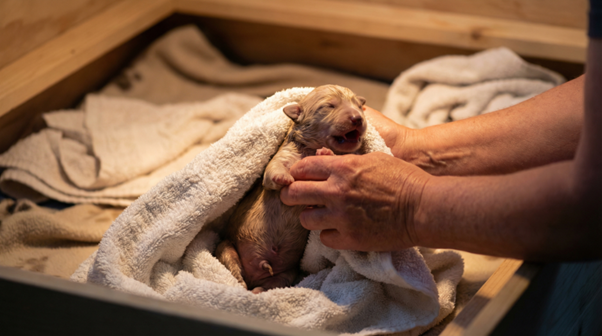
From a clinical perspective, neonatal resuscitation should be viewed as a process of facilitating physiological adaptation. Interventions such as drying, tactile stimulation, and airway clearance may assist in initiating spontaneous breathing. However, when these measures are insufficient, active respiratory support becomes necessary.
Positive pressure ventilation (PPV) plays a central role in promoting lung aeration and reversing hypoxemia. Early initiation of PPV may improve the likelihood of successful transition, particularly in non-vigorous newborns.
Newborns delivered via Cesarean section may require additional support, as they may not benefit from the mechanical and hormonal stimuli associated with vaginal delivery. These individuals may exhibit delayed lung fluid clearance and reduced respiratory drive.
A Physiology-Driven Approach to Care1
Understanding the underlying physiology allows veterinarians to make informed clinical decisions during resuscitation. Rather than viewing neonatal distress as an isolated event, it should be recognized as a disruption of a complex and time-sensitive transition.
Timely and appropriate interventions, guided by physiological principles, may improve outcomes and reduce the risk of complications. Continuous reassessment remains essential, as the transition process is dynamic and may evolve over time.
Conclusion
The transition from fetal to neonatal life involves rapid and coordinated changes in both respiratory and cardiovascular systems. Successful adaptation depends primarily on effective lung aeration and the establishment of pulmonary circulation. When this process is impaired, early and appropriate intervention may be required.
By aligning clinical practice with these physiological principles, veterinarians may be better equipped to support newborn puppies and kittens during this critical period.
Reference
- Boller M, Burkitt‐Creedon JM, Fletcher DJ, Byers CG, Davidson AP, Farrell KS, Bassu G, Fausak ED, Grundy SA, Lopate C, Veronesi MC. RECOVER Guidelines: Newborn Resuscitation in Dogs and Cats. Clinical Guidelines. Journal of Veterinary Emergency and Critical Care. 2025 Aug;35:S60-85. https://onlinelibrary.wiley.com/doi/pdf/10.1111/vec.70013
Related Contents
.jpg)
Video
Transjugular Removal of Canine Heartworms: A Clinical and Surgical Overview
Transjugular removal of canine heartworms is a specialized intervention used in selected dogs with s...

Article
Feline Pregnancy Endocrinology: Hormonal Changes and Placental Function
Pregnancy in cats involves a distinctive endocrine pattern in which ovarian and placental hormones w...

Article
Hormonal Control of Pregnancy Termination in Cats
Pregnancy maintenance in cats depends strongly on coordinated hormonal support, particularly progest...

Article
Feline Embryo Implantation and Early Placental Development
Pregnancy establishment in cats involves a sequence of precisely timed events between fertilization,...

Article
Ultrasonographic Monitoring of Pregnancy in Cats: A Gestational Timeline
Ultrasonography provides a practical way to follow the progression of feline pregnancy by identifyin...

Article
Feline Mismating: Pregnancy Diagnosis and Clinical Management
Mismating or unplanned mating is a common clinical problem in sexually mature queen cats because of...

Article
Medical Termination of Pregnancy in Queens: Drugs, Timing and Treatment Protocols
Medical termination of pregnancy (MTP) in queen cats should be approached according to the timing of...

Article
Safety and Aftercare Following Pregnancy Termination in Queen Cats
Pregnancy termination in queen cats requires more than selecting an appropriate abortifacient. Once...