Article
Airway Management in Newborn Puppies and Kittens: What to Do and What to Avoid
Effective airway management is a fundamental aspect of neonatal resuscitation in puppies and kittens. Immediately after birth, the presence of fluid, mucus, or debris within the airway may impede ventilation. Ensuring airway patency is therefore critical to facilitate lung aeration and support oxygenation during the transition to extrauterine life 1.
Understanding Airway Challenges at Birth
During fetal life, the lungs are fluid-filled, and clearance of this fluid is necessary for effective breathing after birth. While natural mechanisms assist in this process, some neonates—particularly non-vigorous individuals, may require intervention.
Failure to establish a clear airway may result in inadequate ventilation, leading to hypoxemia and secondary bradycardia. Early recognition and management of airway obstruction are therefore essential 1.
Indications for Airway Intervention
Airway intervention should be guided by clinical assessment rather than performed routinely. Indicators that may suggest the need for airway clearance include1:
- Absent or ineffective airflow
- Gasping or irregular breathing
- Visible obstruction within the oropharynx
In the absence of these signs, routine suctioning may not be necessary.
Gentle Suctioning Techniques
When airway clearance is indicated, gentle suctioning using appropriate equipment may be performed. Care should be taken to:
- Use minimal negative pressure
- Limit duration of suctioning
- Avoid repeated or forceful attempts
Excessive suctioning may cause mucosal trauma and may stimulate vagal responses, potentially leading to bradycardia1.
Practices That Should Be Avoided1
Certain traditional techniques have been discouraged in the guidelines. Swinging the neonate to expel fluid is not recommended, as it may increase the risk of intracranial injury without proven benefit.
Similarly, aggressive or repeated airway manipulation without clear indication may delay more effective interventions such as ventilation.
Airway Management and Ventilation
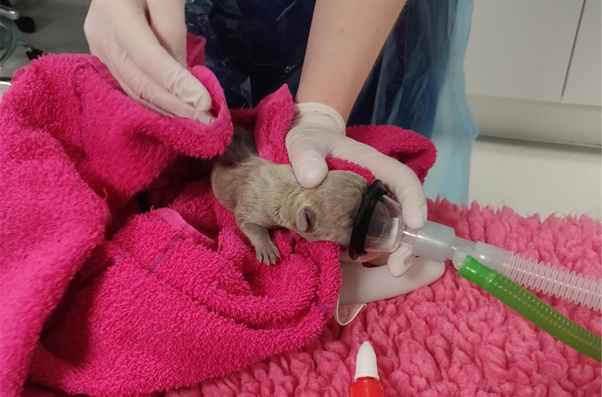
Airway patency is closely linked to the effectiveness of positive pressure ventilation (PPV). Even when PPV is initiated, obstruction within the airway may limit airflow and reduce the effectiveness of ventilation.
Ensuring a clear airway prior to and during ventilation is therefore essential for achieving optimal outcomes1,2.
Ongoing Assessment During Resuscitation1
Airway management should be considered a dynamic process. Continuous reassessment of respiratory effort, airflow, and heart rate is necessary to evaluate the effectiveness of interventions.
Improvement in these parameters may indicate successful airway clearance, while persistent compromise may require further intervention or escalation of care.
Clinical Preparedness1
Veterinary teams should be prepared to manage airway challenges during neonatal resuscitation. This includes ensuring the availability of appropriate suction devices and familiarity with recommended techniques.
Preparation is particularly important in high-risk deliveries, where the likelihood of neonatal compromise may be increased.
Conclusion
Airway management is a key component of neonatal resuscitation in puppies and kittens. By focusing on gentle, indication-based interventions and avoiding potentially harmful practices, veterinarians may support effective breathing and oxygenation. Integration of airway management with ventilation and other supportive measures is essential for facilitating successful neonatal transition.
Reference
- Boller M, Burkitt‐Creedon JM, Fletcher DJ, Byers CG, Davidson AP, Farrell KS, Bassu G, Fausak ED, Grundy SA, Lopate C, Veronesi MC. RECOVER Guidelines: Newborn Resuscitation in Dogs and Cats. Clinical Guidelines. Journal of Veterinary Emergency and Critical Care. 2025 Aug;35:S60-85. https://onlinelibrary.wiley.com/doi/pdf/10.1111/vec.70013
- H. Pike, V. Kolstad, J. Eilevstjønn, et al., “Newborn Resuscitation Timelines: Accurately Capturing Treatment in the Delivery Room,” Resuscitation 197 (2024): 110156. https://www.sciencedirect.com/science/article/pii/S0300957224000492
Related Contents
.jpg)
Video
Transjugular Removal of Canine Heartworms: A Clinical and Surgical Overview
Transjugular removal of canine heartworms is a specialized intervention used in selected dogs with s...

Article
Feline Pregnancy Endocrinology: Hormonal Changes and Placental Function
Pregnancy in cats involves a distinctive endocrine pattern in which ovarian and placental hormones w...

Article
Hormonal Control of Pregnancy Termination in Cats
Pregnancy maintenance in cats depends strongly on coordinated hormonal support, particularly progest...

Article
Feline Embryo Implantation and Early Placental Development
Pregnancy establishment in cats involves a sequence of precisely timed events between fertilization,...

Article
Ultrasonographic Monitoring of Pregnancy in Cats: A Gestational Timeline
Ultrasonography provides a practical way to follow the progression of feline pregnancy by identifyin...

Article
Feline Mismating: Pregnancy Diagnosis and Clinical Management
Mismating or unplanned mating is a common clinical problem in sexually mature queen cats because of...

Article
Medical Termination of Pregnancy in Queens: Drugs, Timing and Treatment Protocols
Medical termination of pregnancy (MTP) in queen cats should be approached according to the timing of...

Article
Safety and Aftercare Following Pregnancy Termination in Queen Cats
Pregnancy termination in queen cats requires more than selecting an appropriate abortifacient. Once...