Article
Poultry Farm Biosecurity and Vaccination: Preventing Disease Introduction and Spread
Disease prevention on a poultry farm depends on more than responding to clinical cases. Farm layout, movement of birds and people, hygiene practices and vaccination all influence the risk of disease introduction and transmission. A consistent biosecurity programme helps protect flock health while reducing the potential for infection to spread between farms.
Biosecurity Begins with Farm Planning
Biosecurity comprises measures designed to prevent disease-causing organisms from entering and spreading within poultry operations. An effective programme requires an understanding of disease epidemiology, economic considerations, and teamwork. Its implementation involves four broad steps:
- Planning and evaluating the programme
- Identifying resources and training personnel
- Implementing measures, including facility construction
- Monitoring results and reviewing procedures[1],[2]
These measures need to account for the production system. In village poultry systems, scavenging birds may share household spaces with people and other livestock. Bird movement and droppings are difficult to control; sick birds may not be isolated, and dead birds may remain accessible to domestic or wild predators. Such conditions create challenges for disease prevention[1],[3].
Structural and Operational Biosecurity
Biosecurity can be divided into two complementary approaches.
Structural biosecurity focuses on the physical arrangement and infrastructure of the farm. Important elements include:
- Appropriate farm layout and fencing
- Drainage and decontamination facilities
- Dedicated change rooms
- Exclusion of rats and wild birds[1]
Conceptual biosecurity also involves arranging poultry operations to separate different types of poultry, limit bird density, and avoid contact with free-living birds[4].
Operational biosecurity covers routine management practices intended to prevent disease entry and spread. These procedures may need modification during an outbreak. Their effectiveness depends on regular protocol assessment, participation across management and labour teams, and appropriate monitoring of flock health and immunity[1].
Sanitation: Reduce Environmental Contamination[1]
Cleaning and disinfection help remove contaminated debris and reduce or eliminate pathogenic organisms on materials and surfaces. Wet cleaning should follow a systematic sequence, moving from one end of the building to the other and from the top downwards.
Following a disease outbreak, hygiene and disinfection should receive particular attention as part of infection control.
Parasite transmission also highlights the importance of sanitation. Personnel and equipment moving between farms, along with rodents, flies and beetles, can mechanically spread oocysts.
Vaccination: Complement, Not Replace, Biosecurity[1]
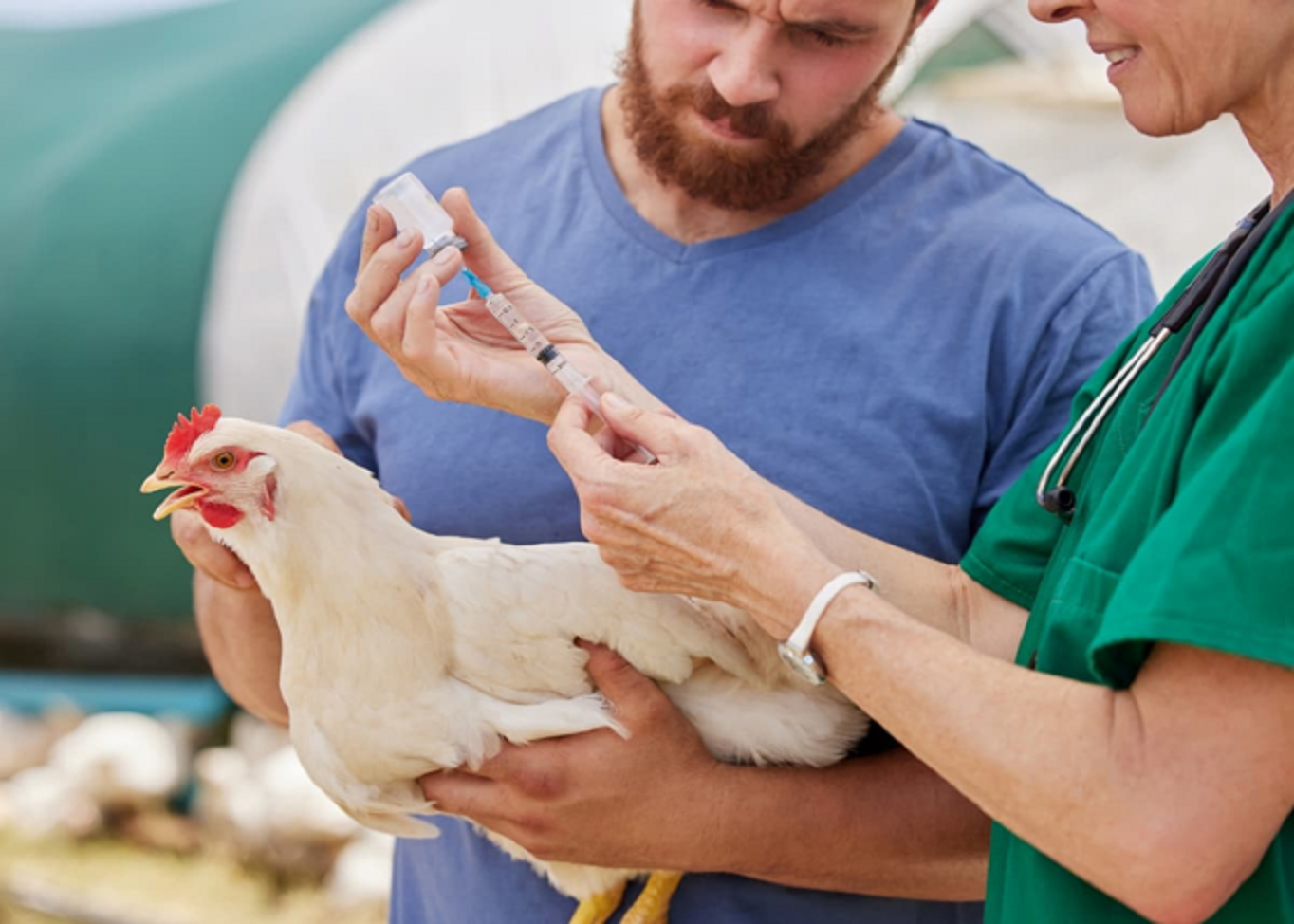
Vaccination is an important disease-management measure, particularly where the risk of introducing and spreading a contagious disease has been identified. It aims to generate protective immunity in the target population, which may be boosted when immediate risk or evidence of field-virus introduction exists.
Vaccination can be combined with effective biosecurity even when no outbreak is occurring, helping protect poultry where exposure is a concern.
However, apparent vaccine failure should not automatically be attributed to vaccine quality. An inadequate cold chain may also be responsible, making investigation of vaccination-related problems important.
Clinical takeaway: Effective poultry disease prevention requires coordinated structural and operational biosecurity, systematic sanitation, flock-health monitoring and appropriate vaccination. Vaccination alone cannot compensate for weaknesses in farm hygiene, movement control or vaccine handling.
References:
- Serbessa TA, Geleta YG, Terfa IO. Review on diseases and health management of poultry and swine. International Journal of Avian & Wildlife Biology. 2023 Apr;7(1):27-38. https://www.researchgate.net/profile/Tagesu-Abdisa/publication/371044181
- Koblentz GD. Biosecurity reconsidered: calibrating biological threats and responses. International security. 2010 Apr 1;34(4):96-132. https://www.researchgate.net/profile/Gregory-Koblentz/publication/254947885_
- Chatterjee RN, Rajkumar U. An overview of poultry production in India. Indian Journal of Animal Health. 2015 Dec;54(2):89-108. https://ijah.in/upload/snippet/76_49.pdf
- Dehinenet Terefe DT, Redeat Belaineh RB, Hassen Chaka HC, Melaku Sombo MS, Abebe Mekuria AM, Getachew Gugsa GG, Kumela Lelisa KL, Delesa Damena DD. Serological and molecular study of Newcastle disease virus in village chickens in selected rift-valley areas, Ethiopia. https://www.researchgate.net/profile/Delesa-Damena/publication/304579051
Related Contents
Article
Recognising Major Bacterial Diseases in Poultry: Clinical Signs and Transmission Clues
Respiratory signs in a poultry flock do not always point to the same bacterial disease. Nasal discha...
Article
Newcastle Disease and Marek’s Disease: Distinguishing Respiratory, Neurological and Paralytic Presentations
A chicken with respiratory distress may have Newcastle disease, but the clinical picture can change...
Article
Poultry Parasitic Diseases: Recognising the Impact of Coccidia, Helminths and Ectoparasites
Parasitic infections can affect poultry productivity even when clinical signs are not immediately ob...
Article
Managing Poultry Health Through Housing, Ventilation, Lighting and Nutrition
A poultry house is more than a shelter. Its temperature, airflow, lighting, feed availability and wa...
Article
Post-Weaning Diarrhoea in Piglets: Recognising Age-Related Enteric Pathogens and Clinical Presentations
The days following weaning represent an important period for monitoring enteric health in piglets. D...
Article
Respiratory and Systemic Diseases in Pigs: Recognising Clinical Patterns Across Production Stages
Respiratory illness in pigs may present as coughing and laboured breathing, while systemic infection...
Article
Swine Herd Biosecurity: Managing Disease Risks Through Animal Movement, Personnel and Farm Operations
A swine herd can face disease exposure through several routine farm activities. Introducing replacem...
Article
Traumatic Reticuloperitonitis vs Traumatic Pericarditis in Cattle and Buffaloes: Recognising the Clinical Differences
A cow presenting with reduced milk production, tachycardia and inappetence may initially raise suspi...