Article
Improving Neonatal Survival After Canine Cesarean Section: Practical Lessons for Veterinary Practice
For the veterinary professional managing canine reproduction, the success of a cesarean section is measured not only by completion of the surgery, but by how many puppies leave the hospital alive. Neonatal survival after c-section depends on multiple interacting factors. Although breed often receives the most attention, evidence suggests that outcomes are strongly influenced by preparation, case selection, surgical timing, and immediate neonatal support, in addition to the patient’s conformation1,2,3.
Clinical data from canine cesarean sections provide several practical lessons that can be applied across both referral and general practice settings. These findings suggest that neonatal survival following c-section can be high, that brachycephalic status alone is not necessarily associated with worse survival to discharge, and that elective surgery offers a meaningful survival advantage compared with emergency intervention¹.
Start With the Most Important Number
One of the most clinically relevant findings is the overall 93.1% neonatal survival to discharge rate. This represents a strong outcome and provides a useful benchmark for veterinary teams evaluating their own reproductive case management.
Survival rates were similar between brachycephalic and nonbrachycephalic breeds. However, survival was significantly better when puppies were delivered via elective c-section rather than emergency surgery¹.
This point deserves emphasis because it represents one of the clearest modifiable factors influencing outcome. Once a bitch presents in advanced dystocia, multiple adverse variables may already be present. Before that point, there is still an opportunity for prevention.
Planned Surgery Is Not Just Convenient, It Is Protective
Neonates were more likely to survive to discharge after elective c-section, regardless of whether the bitch was brachycephalic or nonbrachycephalic. This aligns with previous reports showing poorer outcomes in emergency cases¹.
In emergency patients, several factors were associated with neonatal mortality on univariable analysis, including:
- Stage of labor
- Prior delivery of puppies before surgery
- Attempted medical management of dystocia
- Maternal heart rate
These variables tend to cluster around delayed intervention and increasing obstetric stress.
For veterinarians, this reinforces the importance of identifying high-risk bitches before labor becomes complicated. Elective cesarean section should be considered whenever possible in patients at increased risk for dystocia, as it may reduce complications associated with parturition and improve neonatal survival¹.
Although this recommendation is particularly relevant for brachycephalic breeds, where anatomical risk is well recognized, the broader message is that proactive reproductive management benefits puppies across breed groups.
Litter Size: Read the Number Carefully
One interesting finding was that puppies delivered from larger c-section litters were more likely to survive to discharge compared with those from smaller c-section litters. At first glance, this appears to contradict earlier studies suggesting that increasing litter size can worsen neonatal survival, especially when litters exceed 12 puppies¹. However, the explanation is clinically important.
Many bitches undergoing emergency c-section had already delivered some puppies naturally before dystocia developed and surgery was performed. As a result, the number of puppies delivered surgically appeared smaller even though the total litter size was not.
In fact, total litter size was similar between surviving and nonsurviving puppies, averaging around seven in both groups. This aligns with the litter size range previously associated with the lowest neonatal mortality¹.
The practical takeaway is straightforward: veterinarians should avoid interpreting c-section litter size in isolation. In emergency cases, the number of fetuses removed surgically may reflect delayed intervention rather than the true biological litter size.
Not Every Previously Reported Risk Factor Held Up
Previous studies have suggested that older maternal age and primiparous status increase the risk of neonatal mortality after cesarean section. However, neither factor showed a significant association with survival to discharge in this analysis¹.
Similarly, time from anesthetic induction to delivery of the last puppy did not significantly affect survival.
This does not mean these factors are irrelevant. Maternal age in the population evaluated was relatively low, which may have limited the ability to detect an age effect. In addition, the average time from induction to delivery of the last puppy was under 30 minutes in both surviving and nonsurviving groups1.
When surgical and anesthetic procedures are consistently efficient, the detrimental effects of prolonged anesthesia may be less apparent.
This highlights an important clinical principle: risk factors rarely act in isolation, and their impact often depends on the overall quality and efficiency of perioperative care.
The Team Around the Surgery May Change the Outcome1
One of the most practical observations is that neonatal survival may improve when multiple teams are involved in patient care, with separate personnel responsible for:
- Anesthesia
- Surgery
- Neonatal resuscitation
Although the precise effect of this structure could not be statistically isolated, it likely contributed to the high survival rate observed.
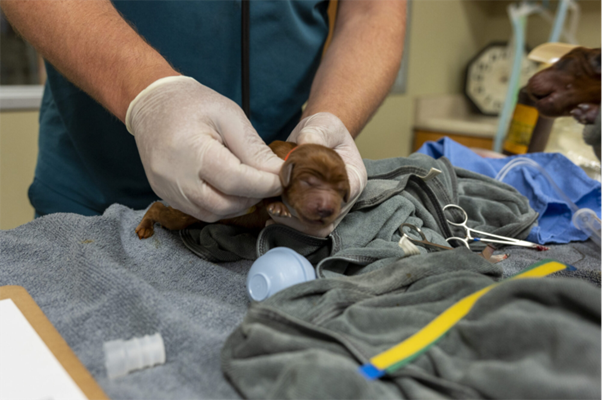
This observation has clear implications for clinical practice. Neonatal outcomes after cesarean section depend not only on surgical technique or anesthetic protocols, but also on whether puppies receive immediate assessment, stimulation, and resuscitation when needed.
In practices where the same team must divide attention between the bitch and several neonates, mortality rates may be higher.
The study also notes that neonatal resuscitation interventions were not specifically recorded, highlighting an important area for future investigation. Nevertheless, the key message is clear: well-organized perioperative teamwork can improve neonatal outcomes.
Conclusion
For veterinary professionals, the key value of these findings lies in their practical application. Neonatal survival after canine cesarean section can be high, but it requires careful planning and coordinated clinical management.
One of the strongest messages from the data is that elective c-section is associated with better neonatal survival than emergency surgery, regardless of whether the bitch is brachycephalic or nonbrachycephalic.
High-risk bitches should be identified early, and client counseling should include realistic discussions about dystocia risk and the benefits of timely intervention. Clinics performing cesarean sections should aim for coordinated perioperative care that supports anesthesia, surgery, and neonatal resuscitation simultaneously.
Breed-related risks remain relevant, but good preparation and proactive management can prevent those risks from translating into poor outcomes. In canine obstetrics, that is a lesson worth applying every day.
References
- Adams DJ, Ellerbrock RE, Wallace ML, Schmiedt CW, Sutherland BJ, Grimes JA. Risk factors for neonatal mortality prior to hospital discharge in brachycephalic and nonbrachycephalic dogs undergoing cesarean section. Veterinary Surgery. 2022 Oct;51(7):1052-60. https://onlinelibrary.wiley.com/doi/pdf/10.1111/vsu.13868
- Runcan EE, da Silva MA. Whelping and dystocia: maximizing success of medical management. Topics in companion animal medicine. 2018 Mar 1;33(1):12-6. https://doi.org/10.1053/j.tcam.2018.03.003
- O'Neill DG, O'Sullivan AM, Manson EA, et al. Canine dystocia in 50 UKfirst-opinion emergency care veterinary practices: prevalence and risk factors. Vet Rec. 2017; 181(4):88. https://doi.org/10.1136/vr.104108
Related Contents
.jpg)
Video
Transjugular Removal of Canine Heartworms: A Clinical and Surgical Overview
Transjugular removal of canine heartworms is a specialized intervention used in selected dogs with s...

Article
Feline Pregnancy Endocrinology: Hormonal Changes and Placental Function
Pregnancy in cats involves a distinctive endocrine pattern in which ovarian and placental hormones w...

Article
Hormonal Control of Pregnancy Termination in Cats
Pregnancy maintenance in cats depends strongly on coordinated hormonal support, particularly progest...

Article
Feline Embryo Implantation and Early Placental Development
Pregnancy establishment in cats involves a sequence of precisely timed events between fertilization,...

Article
Ultrasonographic Monitoring of Pregnancy in Cats: A Gestational Timeline
Ultrasonography provides a practical way to follow the progression of feline pregnancy by identifyin...

Article
Feline Mismating: Pregnancy Diagnosis and Clinical Management
Mismating or unplanned mating is a common clinical problem in sexually mature queen cats because of...

Article
Medical Termination of Pregnancy in Queens: Drugs, Timing and Treatment Protocols
Medical termination of pregnancy (MTP) in queen cats should be approached according to the timing of...

Article
Safety and Aftercare Following Pregnancy Termination in Queen Cats
Pregnancy termination in queen cats requires more than selecting an appropriate abortifacient. Once...