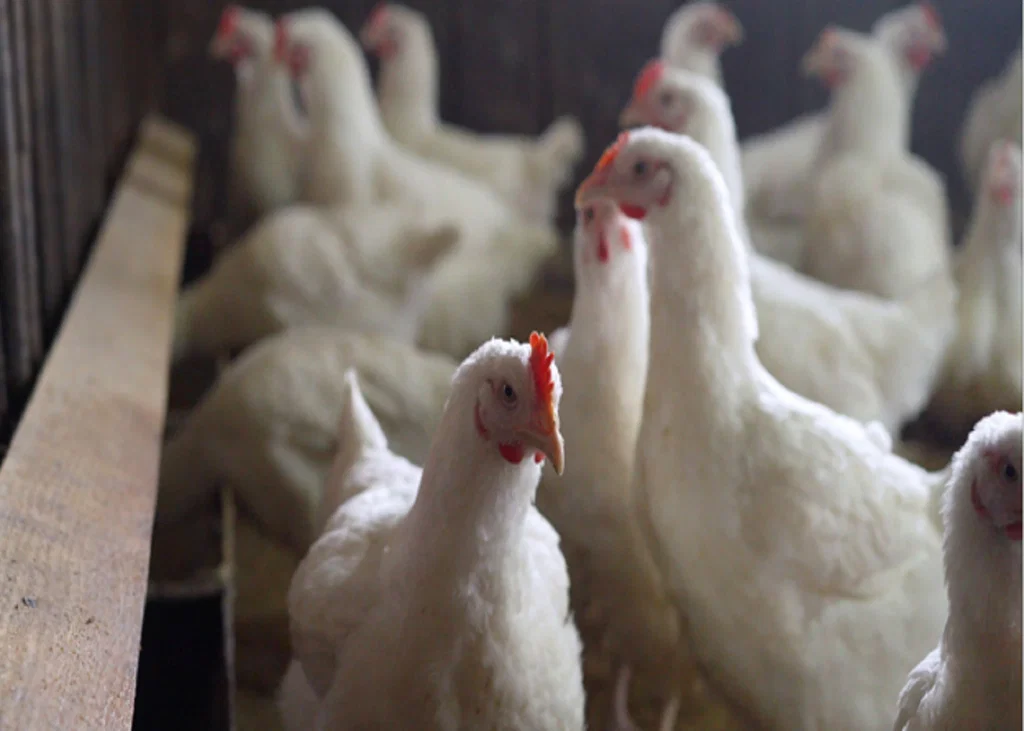
Article
When Coccidiosis and Necrotic Enteritis Affect Broiler Flock Uniformity
A broiler flock can show a noticeable spread in body weight even when birds are exposed to the same production environment. When this happens alongside enteric disease, the focus should not be limited to identifying the pathogen. How differently are individual birds being affected?
Coccidiosis and necrotic enteritis (NE) can impair gut health, feed intake and growth, making them important considerations when poor flock uniformity develops[1],[2],[3].
When intestinal disease translates into uneven growth
Coccidia and Clostridium perfringens can damage the intestine and interfere with normal growth. Reduced feed intake and compromised gut health associated with Eimeria spp. or C. perfringens infections can contribute to differences in body weight between birds[1],[2],[3].
This becomes particularly important when disease severity varies within the flock.
Broilers given identical doses of Eimeria spp. have shown differences in lesion scores across affected gastrointestinal regions[4],[5],[6],[7],[8]. Individual broilers have also shown differences in their response to controlled NE challenge, despite receiving the same challenge[9].
Therefore, equal exposure does not necessarily mean equal intestinal damage or equal effects on growth.
Why can the response differ between birds?[9]
Individual susceptibility can influence the severity of an enteric challenge. Differences in immune function and gut physiology can affect how birds respond to infection.
Variation in response to E. tenella has been associated with both phenotypic and genetic differences. Differences in immune characteristics within a broiler population, as well as genetic variations such as allelic variation and single nucleotide polymorphisms, can also influence susceptibility or resistance to microbial infection.
For a veterinarian assessing a flock, this provides an important context when some birds are growing normally while others are falling behind. The difference may not be explained by exposure alone; birds can respond differently to the same infectious challenge.
Farm-level exposure is rarely identical[9]
Commercial flocks face a more complex situation than a controlled challenge. Birds can encounter different microbial species, and varying pathogen loads within the same production environment.
Multiple Eimeria species and subspecies have been identified within a single farm, and certain species and subspecies have been associated with pronounced reductions in flock uniformity.
Consequently, when poor uniformity accompanies enteric disease, the veterinarian should consider both the type of microbial challenge and the variation in individual response.
What should be assessed in an uneven flock?
When body-weight variation increases alongside suspected enteric disease, several observations can help put the problem into context:
- Is feed intake declining in affected birds?
- Is the flock showing evidence of variable intestinal involvement?
- Could coccidiosis or NE be contributing to reduced growth?
- Are different microbial challenges likely to be present within the house?
- Are some birds responding more severely than others despite similar exposure?
These questions are particularly relevant because enteric disease can influence flock uniformity through more than one pathway. Reduced feed intake and impaired gut health can restrict growth, while differences in immune and physiological responses can widen the gap between individual birds.
At the same time, poor uniformity should not automatically be attributed to pathogen exposure alone. Although greater pathogen challenge could potentially increase variation, a direct relationship between pathogen load or challenge intensity and flock uniformity under commercial conditions has not been established.
Clinical Bottom Line
When coccidiosis or NE occurs alongside poor flock uniformity, assess intestinal health, feed intake and differences in individual disease response together. Birds exposed to the same enteric challenge may not develop the same degree of intestinal involvement or growth impairment. Recognising this variation can help veterinarians interpret uneven flock growth more accurately and determine whether enteric disease is likely to be contributing to the problem.
References:
- Blake DP, Marugan-Hernandez V, Tomley FM. Spotlight on avian pathology: Eimeria and the disease coccidiosis. Avian Pathology. 2021 May 4;50(3):209-13. https://www.tandfonline.com/doi/pdf/10.1080/03079457.2021.1912288
- Goo D, Choi J, Ko H, Choppa VS, Liu G, Lillehoj HS, Kim WK. Effects of Eimeria maxima infection doses on growth performance and gut health in dual-infection model of necrotic enteritis in broiler chickens. Frontiers in Physiology. 2023 Sep 20;14:1269398. https://www.frontiersin.org/journals/physiology/articles/10.3389/fphys.2023.1269398/pdf
- Choi J, Goo D, Sharma MK, Ko H, Liu G, Paneru D, Choppa VS, Lee J, Kim WK. Effects of different Eimeria inoculation doses on growth performance, daily feed intake, gut health, gut microbiota, foot pad dermatitis, and Eimeria gene expression in broilers raised in floor pens for 35 days. Animals. 2023 Jul 7;13(13):2237. https://www.mdpi.com/2076-2615/13/13/2237\
- Choi J, Kong B, Bowker BC, Zhuang H, Kim WK. Nutritional strategies to improve meat quality and composition in the challenging conditions of broiler production: a review. Animals. 2023 Apr 18;13(8):1386. https://www.mdpi.com/2076-2615/13/8/1386
- Choi J, Tompkins YH, Teng PY, Gogal Jr RM, Kim WK. Effects of tannic acid supplementation on growth performance, oocyst shedding, and gut health of in broilers infected with eimeria maxima. Animals. 2022 May 27;12(11):1378. https://www.mdpi.com/2076-2615/12/11/1378
- Choi J, Ko H, Tompkins YH, Teng PY, Lourenco JM, Callaway TR, Kim WK. Effects of Eimeria tenella infection on key parameters for feed efficiency in broiler chickens. Animals. 2021 Dec 1;11(12):3428. https://www.mdpi.com/2076-2615/11/12/3428
- Teng PY, Yadav S, de Souza Castro FL, Tompkins YH, Fuller AL, Kim WK. Graded Eimeria challenge linearly regulated growth performance, dynamic change of gastrointestinal permeability, apparent ileal digestibility, intestinal morphology, and tight junctions of broiler chickens. Poultry science. 2020 Sep 1;99(9):4203-16. https://www.sciencedirect.com/science/article/am/pii/S0032579120303096
- Ko H, Choi J, Goo D, Cervantes HM, Kim WK. Dose-dependent contribution of Eimeria tenella to Salmonella infection in broilers: Impacts on growth, immunity, and cecal microbiota. Poultry Science. 2025 Oct 10:105958. https://www.sciencedirect.com/science/article/pii/S0032579125011988
- Choi J, Goo D, Ko H, Lee J, Kim WK. Factors affecting flock uniformity in broiler production: individual, environmental, and management characteristics. Animals. 2026 Jan 8;16(2):185. https://www.mdpi.com/2076-2615/16/2/185
Related Contents
_Resize_2.jpg)
Upcoming Event
Leptospirosis in Animals: Diagnosis and Zoonotic Prevention
Leptospirosis can cause significant illness in animals and pose a zoonotic risk to humans. Explore c...
Article
Sudden Death in Cattle: A Practical Differential Diagnosis
A cow is found dead during the morning inspection. There were no obvious warning signs the previous...
Article
Caudal Vena Cava Thrombosis in Cattle: Recognising a Fatal Complication of Liver Abscessation
A cow may appear completely healthy until sudden respiratory distress, haemoptysis or death occurs....
Article
Sudden Death in Sheep: Key Differential Diagnoses for the Veterinarian
A sheep found dead on pasture may leave little warning. One animal may have been affected by a rapid...
Article
Sudden Death in Goats: Recognising Peracute Infectious and Metabolic Causes
A goat found dead with little or no warning can leave very few clinical clues. In these cases, the p...
Article
Necrotic Enteritis in Broilers: Identifying the Farm-Level Risk Factors
A broiler flock showing wet litter, poor performance or rising mortality may have several problems o...
Article
Necrotic Enteritis in Broilers: Linking Intestinal Lesions with Laboratory Diagnosis
A broiler may arrive for postmortem examination with a distended, fragile small intestine covered by...
Article
Controlling Necrotic Enteritis Without Antibiotic Growth Promoters: What Can Feed-Based Strategies Offer?
When antibiotic growth promoters are no longer the main option for controlling necrotic enteritis (N...