Article
When Conservative Therapy Fails: Emergency Surgical Management of Haemoperitoneum in Horses
Haemoperitoneum (HP) in horses can rapidly progress from a medically manageable condition to a life-threatening surgical emergency. This case involving a pregnant mare with bilateral granulosa cell tumours (GCTs) highlights the importance of recognising ongoing haemorrhage and making timely surgical decisions.
Acute Clinical Deterioration
Following initial stabilisation and discharge, the mare deteriorated dramatically within 24 hours. Clinical findings included1:
- Tachycardia (90 beats/min)
- Pale mucous membranes
- Prolonged capillary refill time
- Reduced gut sounds
- Progressive weakness
Ultrasonography revealed a marked increase in free abdominal fluid compatible with haemorrhage, while rectal examination identified severe bilateral ovarian enlargement, with both ovaries measuring approximately 15–20 cm.
Laboratory Indicators of Severe Haemorrhage
Serial laboratory findings confirmed progressive cardiovascular compromise1:
- Packed cell volume (PCV) dropped from 24% to 11%
- Total protein (TP) declined to 30 g/L
- Blood lactate increased to 17.6 mmol/L
- Severe hypoxaemia developed despite oxygen supplementation
These findings indicated severe hypovolaemic shock and tissue hypoperfusion.
Key Clinical Insight
Progressive hypoproteinaemia and worsening tachycardia despite therapy strongly suggested ongoing intra-abdominal bleeding.
Emergency Stabilisation
Initial emergency therapy included:
- Whole blood transfusion
- Tranexamic acid
- Hypertonic saline
- Colloid support
- Flunixin meglumine
- Oxygen supplementation
Tranexamic acid was administered to reduce fibrinolysis and stabilise clot formation, although clinical evidence regarding its efficacy in equine haemoperitoneum remains limited2.
Despite aggressive medical management, the mare continued to deteriorate, making surgical intervention essential.
Why Surgery Became Necessary
Medical management was considered unsuccessful because1:
- Tachycardia continued worsening
- PCV and TP kept declining
- Lactate levels rose progressively
- Ongoing haemorrhage was suspected
- Blood transfusions failed to stabilise the mare
At this stage, surgical control of haemorrhage became the only realistic option for survival.
Why Standing Surgery Was Chosen
General anaesthesia was considered extremely high risk due to:
- Severe hypovolaemia
- Anaemia
- Cardiovascular instability
- Metabolic compromise
Anaesthetic agents can significantly depress cardiovascular function in unstable horses and increase perioperative mortality risk1.
Advantages of Standing Surgery
Standing laparoscopic-assisted surgery offered3:
- Reduced cardiovascular depression
- Lower anaesthetic risk
- Faster surgical intervention
- Improved haemodynamic stability
Surgical Management
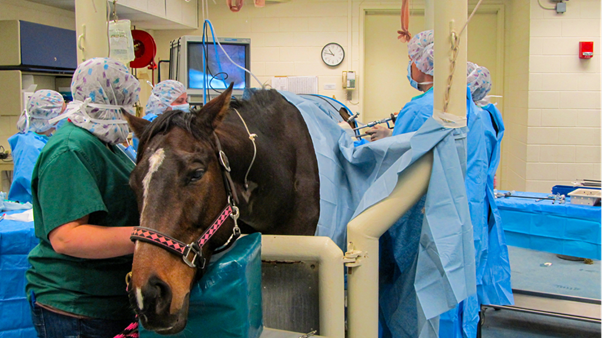
A standing bilateral laparoscopic-assisted ovariectomy was performed.
Perioperative Support Included:
- Blood transfusions
- Antimicrobials
- Morphine analgesia
- Ketamine constant rate infusion
- Colloid therapy
- Local infiltration with mepivacaine
Severe haemoperitoneum significantly impaired laparoscopic visualisation. Therefore, a hand-assisted laparoscopic approach was used to:
- Facilitate blood removal
- Improve palpation
- Enhance visualisation
- Allow direct haemorrhage control
Active bleeding was identified from both ovaries, and the ovarian pedicles were coagulated and transected using a vessel sealing device4.
Postoperative Outcome
Postoperatively, the mare received additional blood transfusions and plasma support. Clinical parameters improved rapidly, including:
- Resolution of tachycardia
- Stabilisation of PCV
- Improved perfusion
- Reduction in abdominal fluid accumulation
Remarkably, the pregnancy remained viable and progressed successfully to term1.
Practical Clinical Takeaways
This case highlights several important lessons for equine practitioners:
- Persistent tachycardia may indicate ongoing haemorrhage
- Serial lactate monitoring is valuable in assessing perfusion
- Falling TP can precede severe PCV decline
- Conservative therapy has limits in active bleeding cases
- Standing laparoscopic surgery can be life-saving in unstable horses
Conclusion
This case demonstrates that progressive tachycardia, worsening lactate, declining TP, and increasing abdominal fluid accumulation should prompt urgent reassessment in horses with haemoperitoneum.
It also highlights that standing laparoscopic-assisted surgery can provide a life-saving alternative to general anaesthesia in critically compromised equine patients.
References
- Sinovich M, Archer DC, Kane‐Smyth J, Scarabelli S, Ritchie A, Kelly PG. Haemoperitoneum associated with bilateral granulosa cell tumours in a pregnant mare treated by standing ovariectomy. Equine Veterinary Education. 2022 Dec;34(12):e526-32. https://beva.onlinelibrary.wiley.com/doi/pdfdirect/10.1111/eve.13612
- Fletcher DJ, Brainard BM, Epstein K, Radcliffe R, Divers T. Therapeutic plasma concentrations of epsilon aminocaproic acid and tranexamic acid in horses. Journal of veterinary internal medicine. 2013 Nov;27(6):1589-95. https://doi.org/10.1111/jvim.12202
- Daniel AJ, Easley JT, Story MR, Hendrickson DA, Hackett ES. Standing hand‐assisted laparoscopic removal of large granulosa cell tumours in horses using a specimen retrieval bag and morcellator. Equine Veterinary Education. 2015 Oct;27(10):505-9. https://doi.org/10.1111/eve.12374
- Colbath AC, Hackett ES, Lesser CS, Hendrickson DA. Left paralumbar laparoscopic bilateral ovariectomy in mares. Veterinary Surgery. 2017 May;46(4):574-9. https://doi.org/10.1111/vsu.12637
Related Contents
.jpg)
Upcoming Event
World Animal Day
World Animal Day highlights the importance of protecting animal health and welfare through responsib...
.jpg)
Video
Transjugular Removal of Canine Heartworms: A Clinical and Surgical Overview
Transjugular removal of canine heartworms is a specialized intervention used in selected dogs with s...

Article
Feline Pregnancy Endocrinology: Hormonal Changes and Placental Function
Pregnancy in cats involves a distinctive endocrine pattern in which ovarian and placental hormones w...

Article
Hormonal Control of Pregnancy Termination in Cats
Pregnancy maintenance in cats depends strongly on coordinated hormonal support, particularly progest...

Article
Feline Embryo Implantation and Early Placental Development
Pregnancy establishment in cats involves a sequence of precisely timed events between fertilization,...

Article
Ultrasonographic Monitoring of Pregnancy in Cats: A Gestational Timeline
Ultrasonography provides a practical way to follow the progression of feline pregnancy by identifyin...

Article
Feline Mismating: Pregnancy Diagnosis and Clinical Management
Mismating or unplanned mating is a common clinical problem in sexually mature queen cats because of...

Article
Medical Termination of Pregnancy in Queens: Drugs, Timing and Treatment Protocols
Medical termination of pregnancy (MTP) in queen cats should be approached according to the timing of...