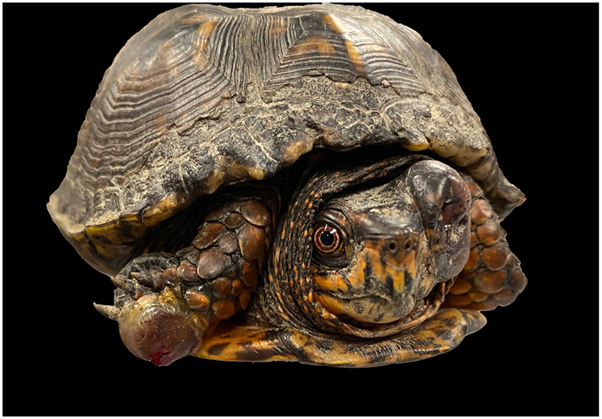
Article
Deep and Systemic Mycoses in Chelonians: What Veterinarians Should Not Miss
Superficial shell lesions in turtles and tortoises are relatively familiar to reptile practitioners. Deep and systemic mycoses, however, remain diagnostically challenging and are often recognized only late in disease progression.
Chelonians appear particularly susceptible to opportunistic fungal invasion under conditions of stress, poor husbandry, environmental contamination, trauma, or immunosuppression1. In wildlife cases, diagnosis becomes even harder because many animals are presented only when severely debilitated or postmortem examination is performed.
Yet accumulating reports suggest that systemic fungal disease in chelonians may be more common than previously assumed.
Pulmonary Disease: The Most Frequent Presentation1
Deep mycoses are reported more frequently in tortoises than aquatic turtles, with pulmonary involvement being the dominant presentation.
Predisposing factors commonly include:
- Overcrowding
- Poor water quality
- Temperature drops
- Concurrent bacterial or parasitic infections
- Foreign body injuries
- Stress during rehabilitation
Respiratory signs may be vague initially:
- Lethargy
- Open-mouth breathing
- Buoyancy abnormalities
- Nasal discharge
- Anorexia
- Chronic weight loss
Because reptiles often mask illness, advanced disease may already exist when clinical signs become apparent.
Which Fungi Are Involved?
The diversity of reported fungal pathogens is remarkable.
Aspergillus and environmental molds
Generalized aspergillosis was reported in turtles as early as 19341. Since then, multiple environmental fungi have been associated with systemic disease.
Entomopathogenic fungi
Purpureocillium lilacinum, Beauveria bassiana, Isaria fumosorosea, and Metarhizium species have all been implicated in pulmonary or disseminated infections in chelonians1,2,3.
This is clinically important because these fungi are traditionally considered insect pathogens. Their repeated recovery from reptile tissues suggests potential reptilian tropism.
Fusarium species
Fusarium has been linked with severe pneumonia and disseminated disease in sea turtles1. Given the expanding recognition of Fusarium solani species complex organisms, veterinarians should not dismiss these isolates as simple contaminants.
Yeasts
Candida albicans and non-albicans Candida species have been associated with:
- Stomatitis
- Gastritis
- Enteritis
- Pneumonia
- Nephritis
- Septicemia1,4,5
Fatal systemic candidiasis caused by Candida krusei has even been reported in Aldabrachelys gigantea4.
Emerging Diseases Veterinarians Should Watch
Two newer fungal conditions deserve increased clinical awareness.
Emydomyces testavorans infection
This emerging Onygenales fungus causes ulcerative shell and skin lesions in freshwater turtles 1,6,7. Unlike many opportunistic shell diseases, affected turtles may otherwise appear clinically stable.
Characteristic findings include:
- Shell pitting
- Hyperkeratosis
- Keratin inclusion cysts
- Osteonecrosis
- Chronic shedding1,6,7
Importantly, lesions may extend internally into the coelomic cavity, making underdiagnosis a significant concern.
Microsporidiosis
Microsporidial infection has recently been reported in Testudo hermanni boettgeri with granulomatous hepatitis and pneumonia8. Cases were associated with significant mortality following hibernation.
Although still rarely documented, veterinarians should consider microsporidia in unexplained multisystemic disease outbreaks.
Clinical Management: Practical Challenges
Treatment data in the literature remain limited, particularly for wildlife cases. Nevertheless, several practical principles emerge consistently.
Successful management requires:
- Correction of husbandry deficiencies
- Environmental decontamination
- Temperature optimization
- Nutritional stabilization
- Targeted antifungal selection when culture is available
- Long-term monitoring
Environmental control is often as important as pharmacological therapy.
In captive collections, recurrent fungal disease should prompt evaluation of:
- Humidity gradients
- Water filtration systems
- Substrate contamination
- Biosecurity gaps
- Chronic stressors
A Changing Landscape in Reptile Medicine
Historically, many fungal isolates in reptiles were considered incidental contaminants. Current evidence suggests otherwise. Emerging fungal pathogens, including Fusarium species complexes and Emydomyces testavorans, are increasingly behaving as true pathogens with conservation implications [76,82,97].
For veterinarians, this means fungal disease in chelonians should no longer be approached as merely secondary shell rot. In many cases, it represents a complex interaction between environmental stress, host immunity, and increasingly adaptive fungal organisms.
References
- Nardoni S, Mancianti F. Mycotic diseases in chelonians. Journal of Fungi. 2023 Apr 27;9(5):518. https://www.mdpi.com/2309-608X/9/5/518
- Schumacher VL, Mangold B, Lenzycki J, Hinckley L, Sutton DA, Frasca Jr S. Occurrence of fruiting structures allows determination of Purpureocillium lilacinum as an inciting agent of pleuritis and pneumonia in a loggerhead sea turtle (Caretta caretta) by histopathologic correlation to culture. Medical mycology case reports. 2014 Oct 1;6:42-5. https://www.sciencedirect.com/science/article/pii/S2211753914000384
- Arpini CM, Nóbrega YC, Castheloge VD, Neves DS, Tadokoro CE, da Costa GL, Oliveira MM, de Deus Santos MR. Purpuriocillium lilacinum infection in captive loggerhead sea turtle hatchlings. Medical mycology case reports. 2019 Mar 1;23:8-11. https://www.sciencedirect.com/science/article/pii/S2211753918300575
- Iannaccone M, Basso PR, Congiu T, Cavicchio P, Ulivi V, Campolo M. Multiple Organ Dysfunction Syndrome (MODS) induced by Candida krusei in an Aldabra giant tortoise (Aldabrachelys gigantea) and confirmed by electron microscopy analysis. Medical mycology case reports. 2018 Sep 1;21:44-8. https://www.sciencedirect.com/science/article/pii/S2211753918300459
- Wang WL, Sun PL, Kao CF, Li WT, Cheng IJ, Yu PH. Disseminated candidiasis and candidemia caused by Candida palmioleophila in a green sea turtle (Chelonia mydas). Animals. 2021 Dec 7;11(12):3480. https://www.mdpi.com/2076-2615/11/12/3480
- Woodburn DB, Miller AN, Allender MC, Maddox CW, Terio KA. Emydomyces testavorans, a new genus and species of onygenalean fungus isolated from shell lesions of freshwater aquatic turtles. Journal of Clinical Microbiology. 2019 Feb;57(2):10-128. https://journals.asm.org/doi/pdf/10.1128/jcm.00628-18
- Lambert MR, Hernández-Gómez O, Krohn AR, Mutlow A, Patterson L, Rosenblum EB, Timmer M, Willis J, Bushell J. Turtle shell disease fungus (Emydomyces testavorans): first documented occurrence in California and prevalence in free-living turtles. Ichthyology & Herpetology. 2021 Dec 1;109(4):958-62. https://www.ichthyologyandherpetology.org/s/04-IH-109-04-06_958962.pdf
- Eydner M, Donhauser J, Beineke A, Guenther P, Blahak S. Microsporidiosis in four tortoises (Testudo hermanni boettgeri). Veterinary pathology. 2017 Jul;54(4):704-9. https://journals.sagepub.com/doi/pdf/10.1177/0300985817691579
Related Contents

Article
FGF-23 in Feline CKD: An Early Signal of Phosphate Dysregulation
A cat with early chronic kidney disease (CKD) may have a normal serum phosphate concentration. Does...

Article
Albuminuria or Transferrinuria? Reading the Glomerular Signal in Feline CKD
A cat can have chronic kidney disease (CKD) with only mild proteinuria. So, when urinary protein is...
Article
Tubular Injury Biomarkers in Feline CKD: What Can NGAL, KIM-1 and L-FABP Tell You?
When feline CKD is already suspected, identifying reduced renal function is only part of the clinica...
Article
Can Renal Fibrosis Biomarkers Reveal CKD Progression in Cats?
Chronic kidney disease in cats is not only a problem of declining renal function. Structural changes...
Article
When Creatinine May Not Tell the Full Story in Feline Acute Kidney Injury
Serum creatinine is routinely used with changes in urine output to diagnose and grade Acute Kidney I...
Article
When a Normal-Looking Udder Hides Mastitis: Recognising Subclinical Mastitis in Buffaloes
A buffalo can appear clinically normal while mastitis is already affecting the udder and milk produc...
Article
Buffalo Subclinical Mastitis: Which Risk Factors Should Vets Investigate?
When subclinical mastitis (SCM) keeps appearing in a buffalo herd, looking only at the affected anim...
Article
Diagnosing Subclinical Mastitis in Buffaloes: From SCC and CMT to Molecular Tests
Subclinical mastitis (SCM) can remain hidden because the buffalo may show no obvious udder or milk a...