Article
Beyond Corrective Shoeing: Can Clodronate Improve Outcomes in Navicular Syndrome?
Navicular syndrome remains one of the most frequent causes of chronic forelimb lameness in athletic horses, particularly dressage horses and show jumpers1. Rather than being a single disease, it represents pain arising from the navicular apparatus, including the navicular bone, deep digital flexor tendon (DDFT), navicular bursa, collateral and impar ligaments, and the distal interphalangeal joint2.
Why Is Navicular Syndrome Challenging?
The condition is multifactorial, involving a combination of:
- Biomechanical overload
- Vascular compromise
- Chronic inflammation
- Bone and soft tissue degeneration
Histopathological studies have identified thinning of trabeculae, fibroplasia, and increased intratrabecular spaces within the navicular bone, suggesting an active bone-remodelling component3.
Where Does Clodronate Fit In?
Clodronate is a bisphosphonate (BP) approved for equine use. Bisphosphonates are widely used in human medicine to manage bone disorders and work primarily by inhibiting osteoclast activity, thereby reducing bone resorption2.
Beyond their effects on bone, bisphosphonates may also:
- Reduce inflammatory cytokine production
- Decrease nitric oxide release from activated inflammatory cells
- Provide analgesic benefits
These additional properties have generated interest in their use for horses with navicular syndrome.
What Does the Research Show?
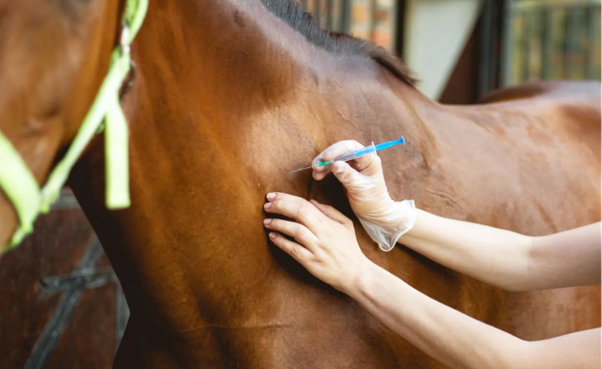
A clinical study evaluating a single intramuscular administration of 765 mg clodronic acid in horses with navicular syndrome reported encouraging results2.
Key Findings
- 55% of horses (6/11) showed meaningful clinical improvement.
- Improved horses experienced an average two-grade reduction in AAEP lameness score.
- Some horses became completely sound within the 90-day follow-up period.
- Improvements were evident from 30 days after treatment and continued through the study period.
Objective gait analysis supported these findings, demonstrating:
- Increased stride length
- Improved stride regularity and symmetry
- Greater dorsoventral movement of the centre of gravity
- Reduced stride frequency
These changes are consistent with improved limb loading and reduced pain.
How Does Clodronate Work?
The exact mechanism remains uncertain.
Earlier theories suggested that bisphosphonates improve lameness by reducing bone resorption. However, more recent work found that neither clodronate nor tiludronate significantly altered bone remodelling parameters within 60 days of treatment4.
As a result, many researchers now believe the clinical benefits may be driven largely by:
- Anti-inflammatory effects
- Pain-modulating properties
- Reduced cytokine activity
rather than direct changes in bone metabolism.
Why Don’t All Horses Respond?
Not every horse benefits from treatment. In the study, 45% of horses showed little or no clinical improvemen2t.
Possible reasons include:
- Chronic versus acute disease
- Concurrent soft tissue injuries
- Variations in lesion severity
- Differences in exercise history and management
- Potential need for repeat treatments
MRI findings in some non-responders revealed additional pathology beyond the navicular bone, highlighting the complexity of the syndrome.
Clinical Take-Home Message
Clodronate can be a valuable adjunct in the management of navicular syndrome, particularly in horses with significant lameness. Current evidence suggests that approximately half of affected horses may experience meaningful clinical improvement following a single treatment, with benefits becoming apparent within the first month.
However, clodronate should not be viewed as a standalone solution. Accurate diagnosis, corrective farriery, exercise management, and evaluation of concurrent soft tissue injuries remain essential for successful long-term outcomes.
References
- Parkes R, Newton R, Dyson S. Is there an association between clinical features, response to diagnostic analgesia and radiological findings in horses with a magnetic resonance imaging diagnosis of navicular disease or other injuries of the podotrochlear apparatus?. The veterinary journal. 2015 Apr 1;204(1):40-6. https://www.researchgate.net/publication/270913537
- Argüelles D, Saitua A, de Medina AS, Muñoz JA, Muñoz A. Clinical efficacy of clodronic acid in horses diagnosed with navicular syndrome: A field study using objective and subjective lameness evaluation. Research in veterinary science. 2019 Aug 1;125:298-304. https://helvia.uco.es/bitstream/handle/10396/31025/clinical_efficacy_of_clodronic_acid_in_horses.pdf?sequence=3
- Dyson S, Blunden T, Murray R. Comparison between magnetic resonance imaging and histological findings in the navicular bone of horses with foot pain. Equine Veterinary Journal. 2012 Nov;44(6):692-8. https://doi.org/10.1111/j.2042-3306.2012.00565.x
- Richbourg HA, Mitchell CF, Gillett AN, McNulty MA. Tiludronate and clodronate do not affect bone structure or remodeling kinetics over a 60 day randomized trial. BMC veterinary research. 2018 Mar 20;14(1):105. https://doi.org/10.1186/s12917-018-1423-2
Related Contents

Article
The Elephant is Walking Differently: Where Should the Investigation Begin?
When an elephant begins walking differently, the first challenge is not necessarily to identify the...
Article
When an Elephant’s Blood Report Says “Abnormal”: How Should It Be Interpreted?
A laboratory report can flag a value as abnormal even when an elephant appears clinically healthy. C...
.jpg)
Upcoming Event
World Animal Day
World Animal Day highlights the importance of protecting animal health and welfare through responsib...
Video
Rabies: Epitome of the One Health Paradigm
Rabies exemplifies the One Health approach, linking animal health, human health, veterinary services...

Video
One Health Webinar on Important Updates on Rabies for Veterinary Practitioners and Students
Rabies remains a major zoonotic disease requiring vigilance across veterinary practice and public he...
.jpg)
Video
Transjugular Removal of Canine Heartworms: A Clinical and Surgical Overview
Transjugular removal of canine heartworms is a specialized intervention used in selected dogs with s...

Article
Feline Pregnancy Endocrinology: Hormonal Changes and Placental Function
Pregnancy in cats involves a distinctive endocrine pattern in which ovarian and placental hormones w...

Article
Hormonal Control of Pregnancy Termination in Cats
Pregnancy maintenance in cats depends strongly on coordinated hormonal support, particularly progest...