Article
Why Pain Management in Sea Turtles Is Still One of Veterinary Medicine's Biggest Challenges
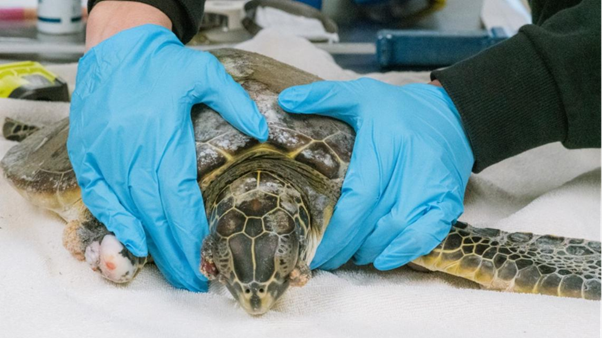
Sea turtle rehabilitation is rarely simple. Veterinarians working in rescue and rehabilitation centers routinely encounter animals suffering from boat-strike trauma, fishing hook ingestion, entanglement injuries, shell fractures, limb amputations, and postoperative complications following gastrointestinal surgeries. These are conditions that would unquestionably require analgesia in mammals, yet pain management in sea turtles remains one of the biggest unresolved challenges in exotic animal medicine.
The issue is not whether sea turtles experience pain. The real challenge lies in recognizing, assessing, and safely treating it.
Reptiles Do Feel Pain
For years, reptiles were mistakenly considered less sensitive to pain because they do not display pain the same way mammals do. However, growing evidence has shown that reptiles possess the neurological structures required for pain perception, including nociceptors, spinal pain pathways, opioid receptors, and higher brain processing centers1,2,3.
Studies have also identified neurotransmitters such as substance P and endogenous opioids within reptilian nervous systems, suggesting that reptiles process painful stimuli through mechanisms comparable to other vertebrates. Researchers now agree that reptiles can not only detect harmful stimuli but can also modify their behavior to avoid similar painful experiences in the future1,4.
For clinicians, this means painful conditions in sea turtles should never be underestimated simply because the patient appears quiet or immobile.
Why Pain Assessment Is So Difficult
Unlike dogs or cats, sea turtles rarely show obvious signs of pain. As prey species, reptiles naturally mask weakness as a survival strategy1. This evolutionary adaptation makes clinical assessment extremely complicated, especially in wild animals already stressed by captivity and handling.
Even standard indicators used in mammals often fail in chelonians. Their shell prevents many visible postural changes associated with pain, while appetite reduction, decreased movement, or altered swimming behavior may be linked to stress, illness, or environmental changes rather than pain alone.
The review highlights several possible indicators veterinarians may observe in painful turtles:
- reluctance to swim,
- reduced feeding activity,
- altered respiratory patterns,
- increased defensive reactions during handling1
However, interpreting these signs remains difficult because no validated sea turtle-specific pain scale currently exists.
The Problem with Current Analgesic Research
One of the biggest frustrations in reptile medicine is the lack of reliable analgesic studies. Many experimental trials still depend on thermal withdrawal tests, where reptiles respond to heat stimuli1. But because reptiles are ectothermic, their response to temperature differs significantly from mammals.
This raises important clinical questions. Is delayed withdrawal truly evidence of analgesia, or is it related to thermoregulation and species-specific heat tolerance? These uncertainties have made many pain studies difficult to interpret.
The same problem extends to analgesic drugs. Butorphanol, commonly used in reptile medicine, has shown inconsistent results across studies1,5,6. Morphine appears more promising in some pain models, although respiratory depression remains a concern at higher doses1. NSAIDs such as meloxicam and ketoprofen are frequently used clinically, but most available research focuses on pharmacokinetics rather than proven analgesic efficacy1,7,8,9,10.
Adding to the complexity, significant species differences exist even among sea turtles themselves. Loggerhead, green, and Kemp’s ridley turtles metabolize drugs differently, making dosage extrapolation risky10.
Moving Toward Better Pain Management1
Despite the limitations, one message is clear: absence of visible pain does not mean absence of suffering. Veterinarians managing traumatic injuries, surgeries, or severe inflammatory conditions in sea turtles should assume pain is present and address it appropriately.
At the same time, the review strongly cautions against blindly applying mammalian analgesic protocols to reptiles without species-specific evidence. Until more validated studies become available, clinicians must balance analgesic benefits with potential risks and rely on careful monitoring during rehabilitation.
Conclusion
Pain management in sea turtles remains a developing field filled with unanswered questions. While research confirms that reptiles possess the anatomical and physiological ability to experience pain, veterinarians still lack reliable assessment tools and validated analgesic protocols for many species. As sea turtle rescue medicine continues to evolve, improving pain recognition and developing safer, evidence-based analgesic strategies will remain essential priorities in wildlife rehabilitation.
Reference
- Serinelli I, Soloperto S, Lai OR. Pain and pain management in sea turtle and herpetological medicine: State of the art. Animals. 2022 Mar 10;12(6):697. https://www.mdpi.com/2076-2615/12/6/697
- Raja SN, Carr DB, Cohen M, Finnerup NB, Flor H, Gibson S, Keefe FJ, Mogil JS, Ringkamp M, Sluka KA, Song XJ. The revised International Association for the Study of Pain definition of pain: concepts, challenges, and compromises. Pain. 2020 Sep 1;161(9):1976-82. https://pmc.ncbi.nlm.nih.gov/articles/PMC7680716/pdf/nihms-1596925.pdf
- Sneddon LU, Elwood RW, Adamo SA, Leach MC. Defining and assessing animal pain. Animal behaviour. 2014 Nov 1;97:201-12. https://www.wellbeingintlstudiesrepository.org/cgi/viewcontent.cgi?article=1068&context=acwp_arte
- Naumann RK, Ondracek JM, Reiter S, Shein-Idelson M, Tosches MA, Yamawaki TM, Laurent G. The reptilian brain. Current Biology. 2015 Apr 20;25(8):R317-21. https://www.cell.com/current-biology/pdf/S0960-9822(15)00218-3.pdf
- Kharbush RJ, Gutwillig A, Hartzler KE, Kimyon RS, Gardner AN, Abbott AD, Cox SK, Watters JJ, Sladky KK, Johnson SM. Antinociceptive and respiratory effects following application of transdermal fentanyl patches and assessment of brain μ-opioid receptor mRNA expression in ball pythons. American journal of veterinary research. 2017 Jul 1;78(7):785-95. https://pmc.ncbi.nlm.nih.gov/articles/PMC5584939/pdf/nihms899728.pdf
- Leal WP, Carregaro AB, Bressan TF, Bisetto SP, Melo CF, Sladky KK. Antinociceptive efficacy of intramuscular administration of morphine sulfate and butorphanol tartrate in tegus (Salvator merianae). American journal of veterinary research. 2017 Sep 1;78(9):1019-24. https://www.academia.edu/download/108476200/ajvr.78.9.1019.pdf
- Cerreta AJ, Masterson CA, Lewbart GA, Dise DR, Papich MG. Pharmacokinetics of ketorolac in wild Eastern box turtles (Terrapene carolina carolina) after single intramuscular administration. Journal of veterinary pharmacology and therapeutics. 2019 Mar;42(2):154-9. https://emc.ncsu.edu/wp-content/uploads/sites/309/2018/12/Pharmacokinetics-of-ketorolac-in-wild-Eastern-box-turtles-Terrapene-carolina-carolina-after-single-intramuscular-administration-Lewbart-Papich.pdf
- Thompson KA, Papich MG, Higgins B, Flanagan J, Christiansen EF, Harms CA. Ketoprofen pharmacokinetics of R‐and S‐isomers in juvenile loggerhead sea turtles (Caretta caretta) after single intravenous and single‐and multidose intramuscular administration. Journal of veterinary pharmacology and therapeutics. 2018 Apr;41(2):340-8. https://repository.library.noaa.gov/view/noaa/54857/noaa_54857_DS1.pdf
- Sadler RA, Schumacher JP, Rathore K, Newkirk KM, Cole G, Seibert R, Cekanova M. Evaluation of the role of the cyclooxygenase signaling pathway during inflammation in skin and muscle tissues of ball pythons (Python regius). American journal of veterinary research. 2016 May 1;77(5):487-94. https://www.researchgate.net/profile/Kusum-Rathore/publication/301643312_Evaluation_of_the_role_of_the_cyclooxygenase_signaling_pathway_during_inflammation_in_skin_and_muscle_tissues_of_ball_pythons_Python_regius/links/594a6687458515225a82edc9/Evaluation-of-the-role-of-the-cyclooxygenase-signaling-pathway-during-inflammation-in-skin-and-muscle-tissues-of-ball-pythons-Python-regius.pdf
- Norton TM, Clauss T, Overmeyer R, Stowell S, Kaylor M, Cox S. Multi-injection pharmacokinetics of meloxicam in Kemp’s Ridley (Lepidochelys kempii) and green (Chelonia mydas) sea turtles after subcutaneous administration. Animals. 2021 Dec 10;11(12):3522. https://www.mdpi.com/2076-2615/11/12/3522
Related Contents
.jpg)
Upcoming Event
World Animal Day
World Animal Day highlights the importance of protecting animal health and welfare through responsib...
.jpg)
Video
Transjugular Removal of Canine Heartworms: A Clinical and Surgical Overview
Transjugular removal of canine heartworms is a specialized intervention used in selected dogs with s...

Article
Feline Pregnancy Endocrinology: Hormonal Changes and Placental Function
Pregnancy in cats involves a distinctive endocrine pattern in which ovarian and placental hormones w...

Article
Hormonal Control of Pregnancy Termination in Cats
Pregnancy maintenance in cats depends strongly on coordinated hormonal support, particularly progest...

Article
Feline Embryo Implantation and Early Placental Development
Pregnancy establishment in cats involves a sequence of precisely timed events between fertilization,...

Article
Ultrasonographic Monitoring of Pregnancy in Cats: A Gestational Timeline
Ultrasonography provides a practical way to follow the progression of feline pregnancy by identifyin...

Article
Feline Mismating: Pregnancy Diagnosis and Clinical Management
Mismating or unplanned mating is a common clinical problem in sexually mature queen cats because of...

Article
Medical Termination of Pregnancy in Queens: Drugs, Timing and Treatment Protocols
Medical termination of pregnancy (MTP) in queen cats should be approached according to the timing of...