Article
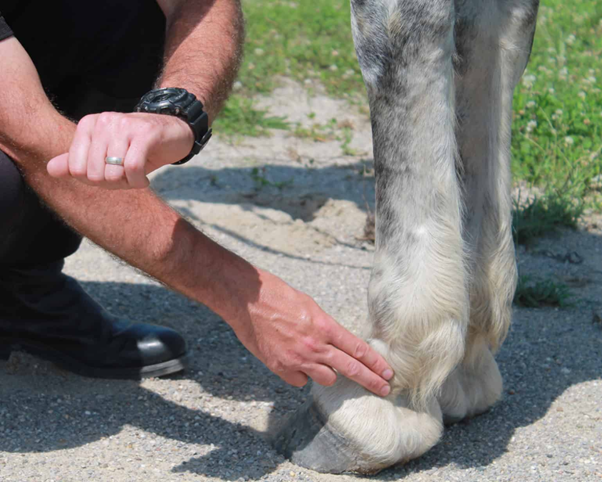
Hyperinsulinaemia-Associated Laminitis: Why Some Horses Recover Slower Than Others
Over the last three decades, research has clearly established insulin dysregulation (ID) as the central mechanism underlying endocrinopathic laminitis1.
When susceptible horses or ponies consume pasture or feeds rich in non-structural carbohydrates (NSCs):
- Blood glucose concentrations rise
- Hyperinsulinaemia develops
- Laminitis may be triggered directly
- 2
Because of this strong metabolic association, the condition is increasingly referred to as hyperinsulinaemia-associated laminitis (HAL)3.
Which Horses Are Most at Risk?
Certain groups appear particularly predisposed to HAL1:
Breed Predisposition
“Easy keeper” breeds such as Welsh ponies are highly susceptible due to efficient glucose metabolism developed through evolutionary adaptation to seasonal feed shortages.
PPID-Associated Risk
Older horses with pituitary pars intermedia dysfunction (PPID) are also vulnerable because PPID is commonly associated with insulin dysregulation.
Obesity and Fat Distribution
While generalized obesity alone may not directly cause laminitis, regional fat accumulation—especially a cresty neck—is strongly linked with insulin dysregulation.
Why Do Some Horses Recover Slowly?
A clinical study evaluating naturally occurring HAL cases identified two distinct recovery patterns4:
- Rapid improvement group: Horses showed marked improvement within approximately 14 days
- Slow improvement group: Horses experienced prolonged recovery with waxing and waning clinical signs over several weeks
This variability was observed despite appropriate veterinary management.
Key Findings From the Study
Glucose and Insulin Matter
Persistently elevated blood glucose and insulin concentrations were most strongly associated with delayed recovery5.
Although individual variation limits their usefulness as standalone prognostic markers, these findings reinforce the importance of metabolic control during rehabilitation.
ACTH Was Not Directly Linked to Recovery Speed
Interestingly:
- ACTH concentrations did not predict recovery rate
- PPID likely contributes indirectly through concurrent insulin dysregulation rather than ACTH itself
Obesity Was Not a Major Predictor
The study also found:
- Generalized obesity was not significantly associated with slower recovery
- Leptin concentrations showed no clear relationship with improvement rate
Radiographs: Helpful but Limited
Radiographic findings did not reliably predict recovery outcomes.
Clinically important observations included1:
- Severe foot pain may occur despite minimal radiographic change
- Radiographic abnormalities can persist long after clinical recovery
- Previous laminitic episodes may complicate interpretation
This highlights the importance of combining radiographic assessment with careful clinical evaluation.
Practical Take-Home Messages for Veterinarians
Focus on Metabolic Management
Successful HAL management requires aggressive metabolic control alongside pain management and hoof support.
Dietary NSC Restriction Is Critical
Strict control of non-structural carbohydrate intake remains a cornerstone of therapy.
Monitor Glucose and Insulin Trends
Persistent elevations may indicate a risk for prolonged recovery.
Emerging Therapies May Help
Glucose-lowering agents such as velagliflozin may offer future therapeutic benefit in difficult cases.
Prepare Owners for Variable Recovery
Recovery timelines can differ substantially, even under optimal management conditions. Clear prognostic counselling is essential.
Conclusion
Hyperinsulinaemia-associated laminitis is fundamentally a metabolic disease rather than simply a hoof disorder. Early recognition, endocrine management, strict nutritional control, and realistic owner communication are critical to improving long-term outcomes in affected horses.
References
- Sillence M, Meier A, de Laat M, Klee R, Reiche D. Demographic, morphologic, hormonal and metabolic factors associated with the rate of improvement from equine hyperinsulinaemia-associated laminitis. BMC veterinary research. 2022 Jan 18;18(1):49. https://doi.org/10.1186/s12917-022-03149-z
- de Laat M, McGowan C, Sillence M, Pollitt C. Equine laminitis: induced by 48 h hyperinsulinaemia in Standardbred horses. Equine Vet J. 2010;42(2):129–35. https://doi.org/10.2746/042516409x475779
- Frank N, Bailey S, Bertin F-R, de Laat M, Durham A, Kritchevsky J, et al. Recommendations for the diagnosis and treatment of equine metabolic syndrome (EMS). Equine Endocrinology Group: Tufts University; 2020. https://sites.tufts.edu/equineendogroup/files/2020/09/200592_EMS_Recommendations_Bro-FINAL.pdf
- Meier A, McGree J, Klee R, Preuß J, Reiche D, de Laat M, Sillence MN. The application of a new laminitis scoring method to model the rate and pattern of improvement from equine endocrinopathic laminitis. BMC Vet Res 2021; 17:16 https://doi.org/https://doi.org/10.1186/s12917-020-02715-7
- Meier A, Reiche D, de Laat M, Pollitt C, Walsh D, Sillence M. The sodiumglucose co-transporter 2 inhibitor velagliflozin reduces hyperinsulinemia and prevents laminitis in insulin-dysregulated ponies. PLoS One 2018;13(9): e0203655. https://doi.org/https://doi.org/10.1371/journal.pone.0203655
Related Contents
.jpg)
Upcoming Event
World Animal Day
World Animal Day highlights the importance of protecting animal health and welfare through responsib...
.jpg)
Video
Transjugular Removal of Canine Heartworms: A Clinical and Surgical Overview
Transjugular removal of canine heartworms is a specialized intervention used in selected dogs with s...

Article
Feline Pregnancy Endocrinology: Hormonal Changes and Placental Function
Pregnancy in cats involves a distinctive endocrine pattern in which ovarian and placental hormones w...

Article
Hormonal Control of Pregnancy Termination in Cats
Pregnancy maintenance in cats depends strongly on coordinated hormonal support, particularly progest...

Article
Feline Embryo Implantation and Early Placental Development
Pregnancy establishment in cats involves a sequence of precisely timed events between fertilization,...

Article
Ultrasonographic Monitoring of Pregnancy in Cats: A Gestational Timeline
Ultrasonography provides a practical way to follow the progression of feline pregnancy by identifyin...

Article
Feline Mismating: Pregnancy Diagnosis and Clinical Management
Mismating or unplanned mating is a common clinical problem in sexually mature queen cats because of...

Article
Medical Termination of Pregnancy in Queens: Drugs, Timing and Treatment Protocols
Medical termination of pregnancy (MTP) in queen cats should be approached according to the timing of...