Article
Current Treatment Approaches for Suspensory Ligament Injuries in Horses
Suspensory ligament (SL) injuries remain one of the most frustrating causes of lameness and lost performance in sport and racehorses. For practitioners, the challenge is not simply getting the horse sound again — it is reducing the risk of reinjury and returning the athlete to work with durable tissue healing1.
Conservative management: still the foundation
The traditional approach to SL injury combines:
- Box rest during the acute phase
- Controlled exercise with gradual loading
- Corrective shoeing to reduce strain on the ligament
Toe wedges can decrease tension on the SL, while wide-toe/narrow-branch shoeing redistributes pressure toward the heels. These adaptations may help some horses, but practitioners should remember they can also increase strain elsewhere in the distal limb1.
Controlled exercise remains essential because progressive loading stimulates better collagen alignment and tissue remodeling. The downside is that reinjury rates after conservative treatment alone are still substantial, especially in the performance of horses.
Surgical options: when conservative care is not enough
Desmoplasty and lesion splitting
Surgical splitting of the injured ligament (desmoplasty) has been used for chronic proximal suspensory desmitis, with early reports showing return to work in treated horses. Experimental work combining ligament splitting with microfracture has also been explored, but robust long-term clinical data are lacking1,2.
Deep branch lateral plantar nerve (DBLPN) neurectomy
DBLPN neurectomy is the most commonly performed surgery for chronic hindlimb proximal suspensory desmitis. The rationale is that chronic inflammation and fibrosis may compress the nerve and contribute to pain1.
Reported return-to-work rates range from 43% to 78% 1,3. Success appears influenced by discipline, conformation, and chronicity of disease. However, the procedure does not restore ligament structure and may lead to muscle atrophy within the proximal SL4. Long-term reinjury data are still limited, and competition rules regarding neurectomy vary between disciplines.
Biologic and regenerative therapies
Regenerative medicine has become central to modern SL management because it targets tissue repair rather than only pain reduction.
Platelet-rich plasma (PRP)
PRP is attractive because it is relatively easy to prepare and delivers concentrated growth factors. Laboratory studies suggest it may promote a more favorable collagen profile and reduce inflammatory signaling5.
Clinical results, however, are mixed:
- Some horses return to previous work levels after PRP treatment.
- Other studies show improvement on ultrasound but only moderate return-to-performance rates.
- Controlled studies are limited, and long-term reinjury rates are inconsistently reported.
Bone marrow and stem cell therapies
Bone marrow aspirate concentrate and mesenchymal stem cells (MSCs) aim to provide both bioactive factors and regenerative cells.
Reported outcomes are promising1:
- About 70% of Standardbreds and Thoroughbreds treated with whole bone marrow aspirate returned to racing.
- Umbilical cord blood-derived MSCs produced return-to-work rates around 68–71% in warmbloods and racehorses.
- Tenogenic primed MSCs have shown particularly encouraging results, including lower reinjury rates compared with saline controls in a randomized trial.
Among regenerative options, tenogenic MSC therapy currently has some of the strongest evidence for improving both short-term healing and long-term durability.
Gene therapy
Experimental gene therapy using plasmids expressing VEGF164 and FGF2 has shown early promise, with most treated horses returning to work without reinjury during 12-month follow-up6. At present, this remains investigational and is not yet a routine clinical option.
Adjunctive therapies: where do they fit?
Extracorporeal shock wave therapy (ESWT)
ESWT may improve ultrasound appearance and stimulate local biological activity. Some clinical studies suggest better return-to-work rates than PRP in Western performance horses. However, the evidence is inconsistent, and its effects on normal ligament tissue remain incompletely understood1.
Practical takeaway: ESWT can be a useful adjunct, especially for chronic proximal suspensory desmitis, but it should not be viewed as a stand-alone curative treatment.
High-power laser and therapeutic ultrasound
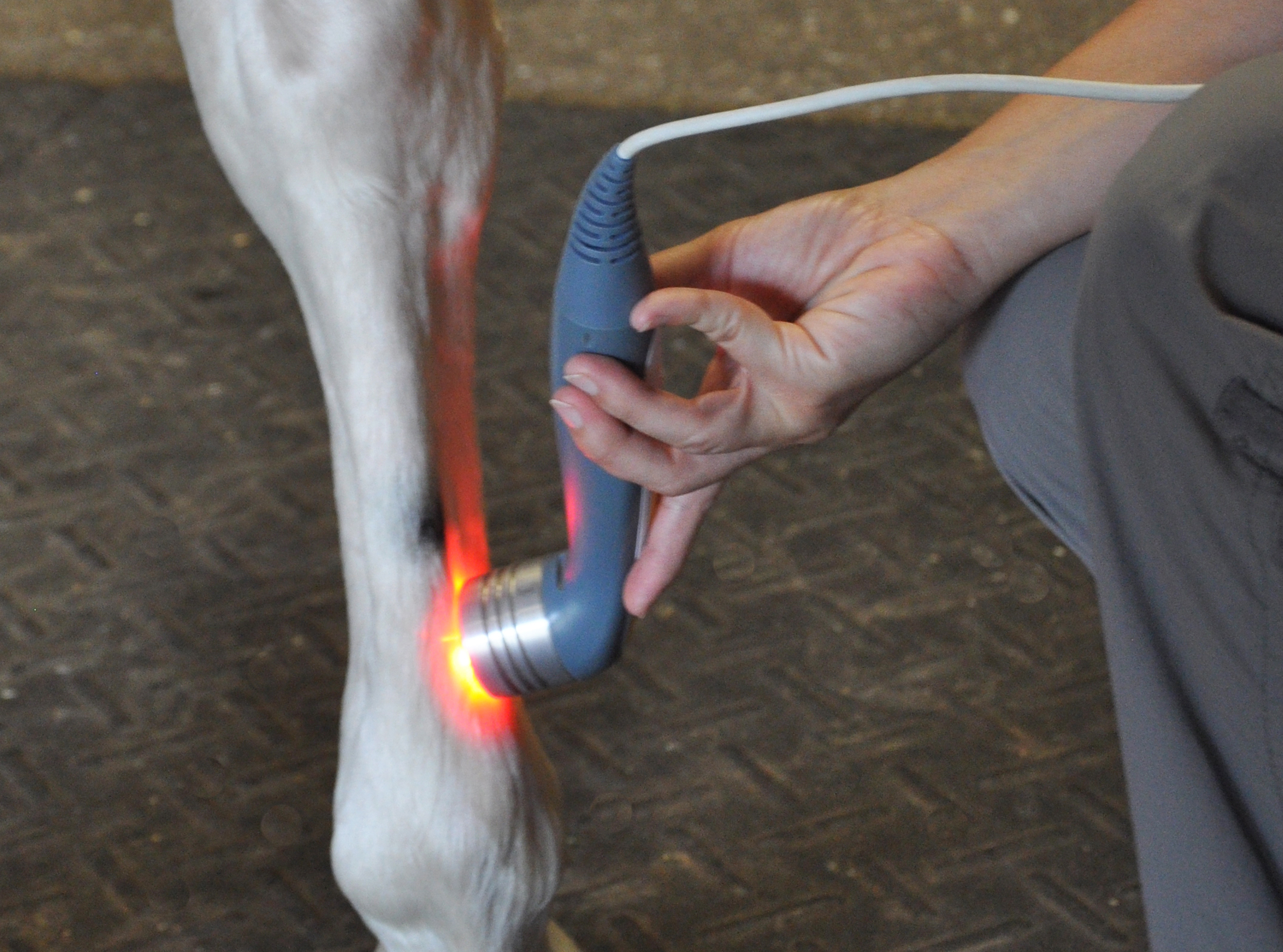
Laser therapy has shown reductions in lesion size and improved histologic appearance in experimental models. Therapeutic ultrasound may enhance local blood flow and tissue metabolism, but clinical evidence is still limited1.
These modalities are best considered supportive tools within a broader rehabilitation program rather than definitive treatments on their own.
Rehabilitation: the overlooked determinant of outcome
Regardless of the primary treatment, rehabilitation quality often determines success. Effective programs should:
- Begin with controlled loading, not prolonged complete rest
- Progress based on lameness, palpation, and imaging findings
- Reintroduce discipline-specific work gradually
- Monitor the contralateral limb and associated structures, as compensatory injuries are common
Water treadmill exercise, dynamic mobilization exercises, and structured strengthening programs can improve joint range of motion, postural control, and stabilizing muscle function during recovery.
What should clinicians tell owners?
Owners often ask, “What treatment gives the best chance of return to sport?” The honest answer is that no single therapy guarantees success. Evidence quality varies widely, and many studies lack control groups or long-term follow-up.
A practical evidence-based hierarchy is1:
|
Treatment category |
Current clinical confidence |
|
Controlled exercise rehabilitation |
High |
|
Corrective shoeing |
Moderate |
|
DBLPN neurectomy (selected chronic cases) |
Moderate |
|
Tenogenic MSC therapy |
Moderate-to-high |
|
PRP |
Moderate |
|
ESWT |
Moderate |
|
Laser/ultrasound modalities |
Low-to-moderate |
|
Gene therapy |
Experimental |
For many performance horses, the best outcomes likely come from combining accurate diagnosis, staged rehabilitation, biomechanical correction, and targeted regenerative therapy rather than relying on any single intervention.
Final thoughts
Suspensory ligament injuries are evolving from a “rest and hope” problem into a biologically managed condition. Advances in MRI diagnosis, regenerative medicine, and structured rehabilitation are improving outcomes, but reinjury remains the major obstacle. For clinicians, the key is matching treatment intensity to lesion severity, chronicity, and athletic demands while maintaining a disciplined rehabilitation program.
References
- Guest DJ, Birch HL, Thorpe CT. A review of the equine suspensory ligament: Injury prone yet understudied. Equine Veterinary Journal. 2025 Sep;57(5):1167-82. https://beva.onlinelibrary.wiley.com/doi/pdfdirect/10.1111/evj.14447
- Brokken MT, Schneider RK, Roberts GD, Holmes SP, Gavin PR, Sampson SN, Farnsworth KD, Dahlgren LA. Evaluation of a new surgical treatment for equine hind limb proximal suspensory desmitis. Veterinary Surgery. 2016 Oct;45(7):868-78. https://doi.org/10.1111/vsu.12527
- Scharf A, de Solis CN, Sampson SN, Glass K, Watts AE. Suspensory ligament size does not change after plantar fasciotomy and neurectomy of the deep branch of the lateral plantar nerve by ultrasonographic assessment. Veterinary Surgery. 2022 Feb;51(2):259-69. https://doi.org/10.1111/vsu.13757
- Antonio GJ, Jim S, Ramés SJ, Rohrbach BW, Rodríguez MA, Romero RL, Robert D. Denervating the pelvic suspensory ligaments of horses causes morphological and histological changes in the ligaments. American Journal of Veterinary Research. 2022 May 1;83(5):399-404. https://avmajournals.avma.org/view/journals/ajvr/83/5/ajvr.21.09.0148.xml
- Bonilla-Gutiérrez AF, Castillo-Franz C, López C, Álvarez ME, Giraldo CE, Carmona JU. Equine suspensory ligament and tendon explants cultured with platelet-rich gel supernatants release different anti-inflammatory and anabolic mediators. Biomedicine & Pharmacotherapy. 2018 Dec 1;108:476-85. https://doi.org/10.1016/j.biopha.2018.09.065
- Kovac M, Litvin YA, Aliev RO, Zakirova EY, Rutland CS, Kiyasov AP, Rizvanov AA. Gene therapy using plasmid DNA encoding VEGF164 and FGF2 genes: a novel treatment of naturally occurring tendinitis and desmitis in horses. Frontiers in Pharmacology. 2018 Aug 31;9:978. https://doi.org/10.3389/fphar.2018.00978
Related Contents
.jpg)
Video
Transjugular Removal of Canine Heartworms: A Clinical and Surgical Overview
Transjugular removal of canine heartworms is a specialized intervention used in selected dogs with s...

Article
Feline Pregnancy Endocrinology: Hormonal Changes and Placental Function
Pregnancy in cats involves a distinctive endocrine pattern in which ovarian and placental hormones w...

Article
Hormonal Control of Pregnancy Termination in Cats
Pregnancy maintenance in cats depends strongly on coordinated hormonal support, particularly progest...

Article
Feline Embryo Implantation and Early Placental Development
Pregnancy establishment in cats involves a sequence of precisely timed events between fertilization,...

Article
Ultrasonographic Monitoring of Pregnancy in Cats: A Gestational Timeline
Ultrasonography provides a practical way to follow the progression of feline pregnancy by identifyin...

Article
Feline Mismating: Pregnancy Diagnosis and Clinical Management
Mismating or unplanned mating is a common clinical problem in sexually mature queen cats because of...

Article
Medical Termination of Pregnancy in Queens: Drugs, Timing and Treatment Protocols
Medical termination of pregnancy (MTP) in queen cats should be approached according to the timing of...

Article
Safety and Aftercare Following Pregnancy Termination in Queen Cats
Pregnancy termination in queen cats requires more than selecting an appropriate abortifacient. Once...