Article
When Is the Appropriate Time to Perform Culture and Sensitivity in Canine Otitis?
Does every dog with otitis need a bacterial culture?
Not necessarily.
One of the most common misconceptions in veterinary practice is that every ear infection requires bacterial culture and antimicrobial susceptibility testing. In reality, ear cytology remains the first-line diagnostic test for most cases of otitis externa, while bacterial culture should be reserved for specific clinical situations where it is likely to influence treatment decisions1,2,3,4.
Knowing when culture is indicated—and when it isn't—helps veterinarians practise responsible antimicrobial stewardship while avoiding unnecessary costs for clients.
Ear Cytology Comes First
Before considering bacterial culture, every dog with otitis should undergo ear cytology.
Cytology provides immediate information on:
- Presence of bacteria or yeast
- Predominant bacterial morphology (cocci or rods)
- Degree of inflammation
- Treatment response during follow-up
For many uncomplicated first-time infections, cytology provides sufficient information to initiate appropriate topical therapy1.
Culture should therefore be viewed as a second-line diagnostic tool, not a replacement for cytology.
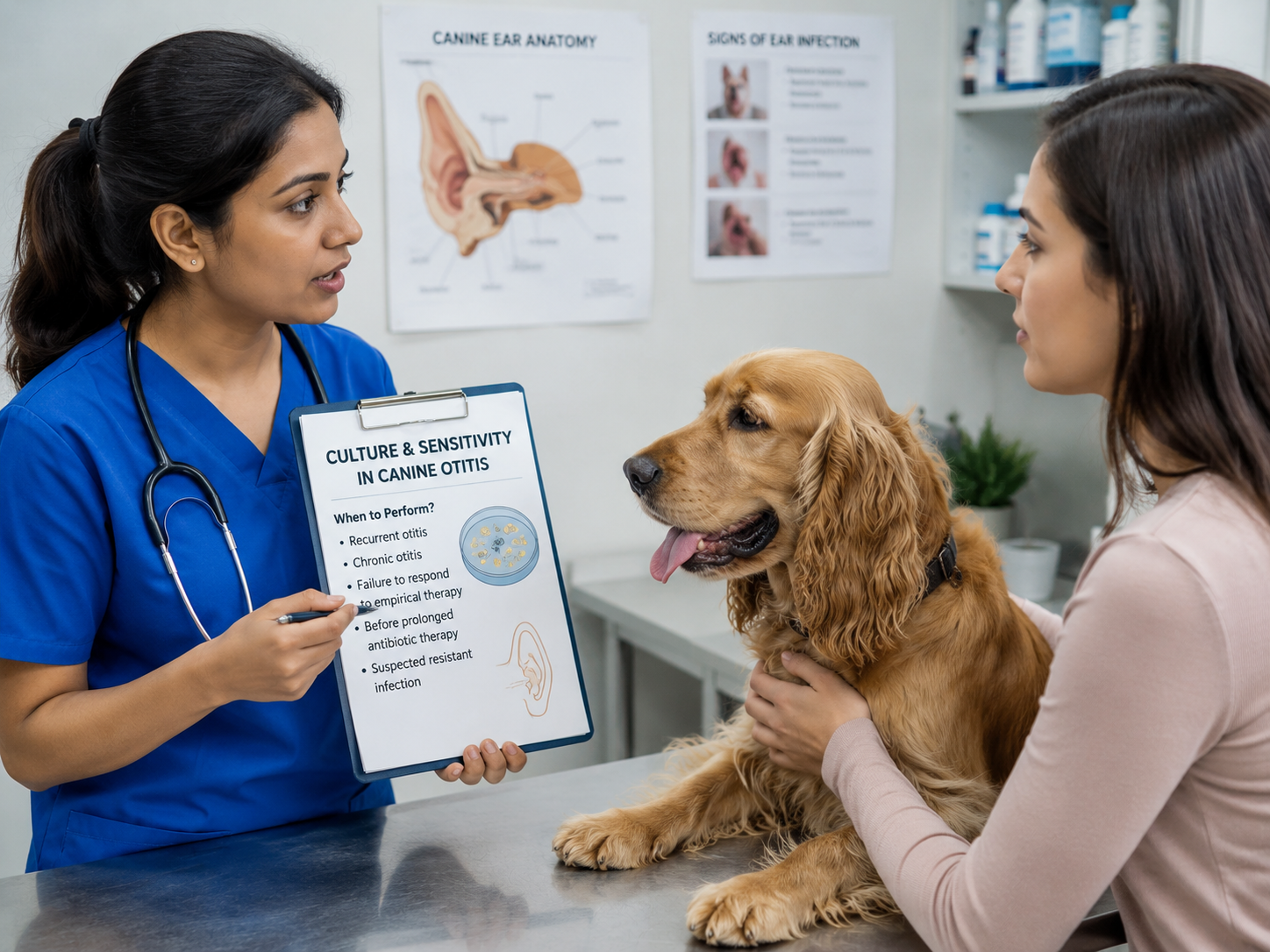
When Is Culture Recommended?
Bacterial culture and susceptibility testing become valuable when the clinical picture is more complicated or when empirical treatment has failed.
1. Chronic or Recurrent Otitis
Dogs presenting with repeated episodes of otitis are among the strongest candidates for culture.
Repeated antimicrobial exposure increases the likelihood of:
- Resistant bacterial populations
- Mixed infections
- Biofilm formation
- Persistent pathogens such as Pseudomonas aeruginosa
Culture helps determine whether the organisms currently present remain susceptible to commonly used topical antibiotics2,3.
2. Rod-Shaped Bacteria on Cytology
Finding rods on cytology should immediately raise suspicion for Gram-negative organisms, particularly Pseudomonas aeruginosa or Proteus species.
These infections are more likely to exhibit antimicrobial resistance and are frequently associated with chronic suppurative otitis2,3.
Rather than repeatedly changing topical medications empirically, culture allows clinicians to select therapy based on susceptibility results.
3. Poor Response to Appropriate Treatment
If the ear appears no better after an appropriate course of treatment—or improves briefly before rapidly relapsing—culture should be strongly considered.
Treatment failure may result from:
- Antimicrobial resistance
- Inappropriate drug selection
- Biofilm formation
- Mixed bacterial populations
- Undiagnosed primary disease
Culture cannot identify the underlying cause of recurrence, but it can determine whether bacterial resistance is contributing to treatment failure.
4. Suspected Multidrug-Resistant Infections
Repeated antimicrobial exposure creates selective pressure for resistant organisms.
Culture becomes particularly valuable in dogs with:
- Multiple previous courses of topical antibiotics
- Previous systemic antibiotic therapy
- Referral cases
- Hospital-associated infections
Early susceptibility testing helps avoid ineffective empirical therapy and supports antimicrobial stewardship3.
5. Otitis Media or Severe Suppurative Otitis
When otitis extends beyond the external ear canal or is accompanied by severe purulent discharge, bacterial culture is strongly recommended.
Obtaining samples from the horizontal ear canal—or preferably the middle ear when indicated—can guide treatment in these challenging cases1,2.
When Culture May Not Be Necessary
Routine culture is often unnecessary for uncomplicated acute otitis externa.
For example:
- First episode of otitis
- Mild coccal infection
- Predominant Malassezia overgrowth
- Good response to previous topical therapy
- No history of antimicrobial failure
In these patients, cytology combined with appropriate topical treatment is usually sufficient1.
Avoiding unnecessary culture also reduces costs without compromising patient care.
Culture Has Limitations
Although bacterial culture remains the clinical gold standard for antimicrobial susceptibility testing, it is not a perfect diagnostic tool.
Recent studies comparing bacterial culture with 16S amplicon sequencing have shown that conventional culture may fail to detect certain bacterial species present within the ear canal, particularly organisms present in low abundance or anaerobic bacteria2.
Conversely, bacteria that grow readily in culture may appear more important than they actually are within the microbial community.
Culture should therefore be interpreted alongside:
- Clinical history
- Cytology
- Otoscopic findings
- Previous treatments
No single diagnostic test should be interpreted in isolation.
Culture Answers One Question—Not Every Question
One common mistake is expecting bacterial culture to explain why otitis keeps recurring.
Culture identifies:
- The bacteria that can be cultured
- Their antimicrobial susceptibility
It does not identify:
- Underlying allergy
- Ear canal anatomy
- Biofilm formation
- Dysbiosis
- Endocrine disease
- Foreign bodies
- Chronic inflammatory changes
This is why recurrent otitis should always be investigated using the Primary–Secondary–Predisposing–Perpetuating (PSPP) approach rather than relying solely on laboratory results1.
Collecting the Right Sample Matters
The quality of the culture depends on the quality of the sample.
Whenever possible:
- Collect samples before ear cleaning or topical medication
- Sample the horizontal ear canal
- Avoid contamination from the pinna or external debris
- Use sterile swabs and appropriate transport media
Poor sampling technique may lead to misleading culture results and inappropriate antimicrobial selection.
Clinical Pearl
Perform bacterial culture because the patient needs it—not because the laboratory offers it.
In uncomplicated otitis, cytology usually provides enough information to begin treatment.
Reserve culture for chronic, recurrent, suppurative or poorly responding cases where the results are likely to change your therapeutic approach.
Key Takeaways
Ear cytology remains the first-line diagnostic test for canine otitis externa. Culture and susceptibility testing are recommended for chronic, recurrent, suppurative or treatment-resistant cases. Rod-shaped bacteria on cytology should prompt consideration of bacterial culture. Culture results should always be interpreted alongside cytology and clinical findings. Culture identifies bacterial susceptibility but does not determine the underlying cause of recurrent otitis.
References
- Bajwa J. Canine otitis externa—Treatment and complications. Canadian Veterinary Journal. 2019;60(1):98–101. PMCID: PMC6294027. https://pmc.ncbi.nlm.nih.gov/articles/PMC6294027/
- Leonard, C.; Thiry, D.; Taminiau, B.; Daube, G.; Fontaine, J. External Ear Canal Evaluation in Dogs with Chronic Suppurative Otitis Externa: Comparison of Direct Cytology, Bacterial Culture and 16S Amplicon Profiling. Vet. Sci. 2022, 9, 366. https://doi.org/10.3390/vetsci9070366
- Secker B, Shaw S, Atterbury RJ. Pseudomonas spp. in Canine Otitis Externa. Microorganisms. 2023;11(11):2650. DOI: 10.3390/microorganisms11112650. PMCID: PMC10671989. https://www.mdpi.com/2076-2607/11/11/2650
- Ponn PC, Tipold A, Volk AV, et al. Can We Minimize the Risk of Dogs Developing Canine Otitis Externa? Animals. 2024;14(17):2537. DOI: 10.3390/ani14172537. PMCID: PMC11394639. Available from: https://pmc.ncbi.nlm.nih.gov/articles/PMC11394639/
Related Contents

Upcoming Event
African Swine Fever: Diagnosis and Management
African swine fever can cause severe disease and significant losses in affected pig populations.&nbs...
.jpg)
Video
Transjugular Removal of Canine Heartworms: A Clinical and Surgical Overview
Transjugular removal of canine heartworms is a specialized intervention used in selected dogs with s...

Article
Feline Pregnancy Endocrinology: Hormonal Changes and Placental Function
Pregnancy in cats involves a distinctive endocrine pattern in which ovarian and placental hormones w...

Article
Hormonal Control of Pregnancy Termination in Cats
Pregnancy maintenance in cats depends strongly on coordinated hormonal support, particularly progest...

Article
Feline Embryo Implantation and Early Placental Development
Pregnancy establishment in cats involves a sequence of precisely timed events between fertilization,...

Article
Ultrasonographic Monitoring of Pregnancy in Cats: A Gestational Timeline
Ultrasonography provides a practical way to follow the progression of feline pregnancy by identifyin...

Article
Feline Mismating: Pregnancy Diagnosis and Clinical Management
Mismating or unplanned mating is a common clinical problem in sexually mature queen cats because of...

Article
Medical Termination of Pregnancy in Queens: Drugs, Timing and Treatment Protocols
Medical termination of pregnancy (MTP) in queen cats should be approached according to the timing of...