Article
Diagnosing Equine Osteoarthritis Earlier: What Every Equine Vet Should Be Using Today
By the time obvious radiographic changes appear, osteoarthritis (OA) has often been active within the joint for months or even years. For equine athletes, this delay can mean progressive cartilage damage, declining performance, and a shortened competitive career1.
Modern OA management is increasingly focused on identifying disease earlier—before irreversible structural damage develops.
For practising veterinarians, combining clinical examination with appropriate imaging and emerging biomarker tools offers the best opportunity to intervene before significant deterioration occurs.
Radiography: Still the First-Line Tool
Radiography remains the most commonly used imaging modality in equine practice. It is valuable for identifying:
- Osteophyte formation
- Subchondral bone sclerosis
- Joint-space narrowing
- Developmental abnormalities
- Advanced degenerative changes
However, radiographs primarily assess bone and provide limited information about soft tissues and early cartilage injury. As a result, radiographic findings do not always correlate with the horse's degree of lameness or disease severity2.
Ultrasonography: Looking Beyond Bone
Ultrasound has become an indispensable companion to radiography in OA workups.
It allows practitioners to evaluate:
- Joint capsules
- Synovial membranes
- Ligaments
- Articular cartilage surfaces
- Early osteochondral irregularities1
Power Doppler ultrasonography can further detect increased synovial vascularization, providing objective evidence of active inflammation and synovitis3.
Emerging techniques such as strain elastosonography may also help identify increased capsular stiffness associated with chronic joint disease4.
Arthroscopy: Direct Assessment of Joint Health
When more detailed evaluation is required, arthroscopy remains the gold standard.
Direct visualization allows assessment of:
- Cartilage integrity
- Synovial inflammation
- Osteochondral lesions
- Ligament injuries
- Intra-articular debris
Research has shown that arthroscopic assessment of synovial membrane appearance correlates closely with histological evidence of inflammation, making it a useful indicator of disease activity1.
Advanced Imaging: MRI and CT Enter the Arena
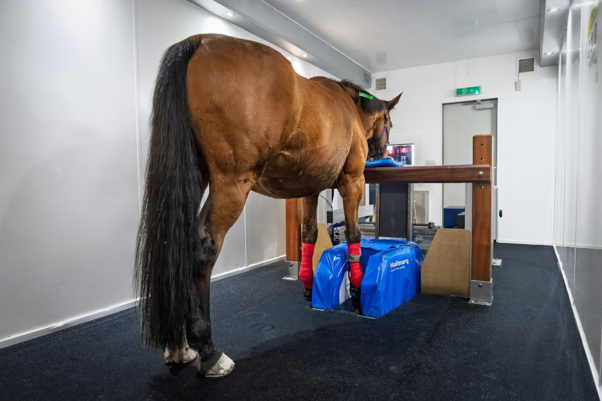
Magnetic resonance imaging (MRI) is becoming increasingly valuable in equine sports medicine.
High-field MRI can detect:
- Cartilage thinning
- Bone marrow edema
- Subchondral bone lesions
- Soft tissue pathology
- Early osteochondral injury1
Even more exciting are quantitative MRI techniques, which can identify biochemical changes in cartilage composition before visible structural damage occurs5.
Similarly, contrast-enhanced CT is providing new opportunities to evaluate cartilage quality, glycosaminoglycan content, and subchondral bone architecture with greater precision1.
Biomarkers: The Future of OA Monitoring?
Researchers are increasingly investigating biomarkers that reflect cartilage degradation and inflammation.
Examples include:
- IL-1 and IL-6
- Matrix metalloproteinases (MMPs)
- ADAMTS-5
- CTX-II
- COMP
- Chondroitin sulfate
- Glycosaminoglycans6,7
Although currently used primarily in research settings, biomarker analysis may eventually become a practical tool for early diagnosis and treatment monitoring.
Take-Home Message
Diagnosing equine OA is no longer limited to identifying radiographic changes. Combining clinical examination with ultrasonography, arthroscopy, advanced imaging, and emerging biomarker technologies enables veterinarians to detect disease earlier and make more informed treatment decisions. In OA management, earlier diagnosis often means a better chance of preserving both joint health and athletic longevity.
References
- Baccarin RY, Seidel SR, Michelacci YM, Tokawa PK, Oliveira TM. Osteoarthritis: a common disease that should be avoided in the athletic horse’s life. Animal Frontiers. 2022 Jun 1;12(3):25-36. https://doi.org/10.1093/af/vfac026
- Barrett MF, Selberg KT, Johnson SA, Hersman J, Frisbie DD. High field magnetic resonance imaging contributes to diagnosis of equine distal tarsus and proximal metatarsus lesions: 103 horses. Veterinary Radiology & Ultrasound. 2018 Sep;59(5):587-96. https://onlinelibrary.wiley.com/doi/abs/10.1111/vru.12659
- Yamada AL, Pinheiro M, Marsiglia MF, Hagen SC, Baccarin RY, da Silva LC. Ultrasound and clinical findings in the metacarpophalangeal joint assessment of show jumping horses in training. Journal of veterinary science. 2020 Jan 7;21(3):e21. https://pmc.ncbi.nlm.nih.gov/articles/PMC7263911/pdf/jvs-21-e21.pdf
- Straticò P, Guerri G, Palozzo A, Di Francesco P, Vignoli M, Varasano V, Petrizzi L. Elastosonographic features of the metacarpophalangeal joint capsule in horses. BMC veterinary research. 2021 May 29;17(1):202. https://link.springer.com/content/pdf/10.1186/s12917-021-02897-8.pdf
- Kajabi AW, Casula V, Sarin JK, Ketola JH, Nykänen O, Te Moller NC, Mancini IA, Visser J, Brommer H, René van Weeren P, Malda J. Evaluation of articular cartilage with quantitative MRI in an equine model of post‐traumatic osteoarthritis. Journal of Orthopaedic Research®. 2021 Jan;39(1):63-73. https://onlinelibrary.wiley.com/doi/pdf/10.1002/jor.24780
- Ma TW, Li Y, Wang GY, Li XR, Jiang RL, Song XP, Zhang ZH, Bai H, Li X, Gao L. Changes in synovial fluid biomarkers after experimental equine osteoarthritis. Journal of veterinary research. 2017 Dec 27;61(4):503. https://sciendo.com/2/v2/download/article/10.1515/jvetres-2017-0056.pdf
- Watkins AR, Reesink HL. Lubricin in experimental and naturally occurring osteoarthritis: a systematic review. Osteoarthritis and cartilage. 2020 Oct 1;28(10):1303-15. https://www.sciencedirect.com/science/article/pii/S1063458420310244
Related Contents

Article
The Elephant is Walking Differently: Where Should the Investigation Begin?
When an elephant begins walking differently, the first challenge is not necessarily to identify the...
Article
When an Elephant’s Blood Report Says “Abnormal”: How Should It Be Interpreted?
A laboratory report can flag a value as abnormal even when an elephant appears clinically healthy. C...
.jpg)
Upcoming Event
World Animal Day
World Animal Day highlights the importance of protecting animal health and welfare through responsib...
Video
Rabies: Epitome of the One Health Paradigm
Rabies exemplifies the One Health approach, linking animal health, human health, veterinary services...
Video
One Health Webinar on Important Updates on Rabies for Veterinary Practitioners and Students
Rabies remains a major zoonotic disease requiring vigilance across veterinary practice and public he...
.jpg)
Video
Transjugular Removal of Canine Heartworms: A Clinical and Surgical Overview
Transjugular removal of canine heartworms is a specialized intervention used in selected dogs with s...

Article
Feline Pregnancy Endocrinology: Hormonal Changes and Placental Function
Pregnancy in cats involves a distinctive endocrine pattern in which ovarian and placental hormones w...

Article
Hormonal Control of Pregnancy Termination in Cats
Pregnancy maintenance in cats depends strongly on coordinated hormonal support, particularly progest...